
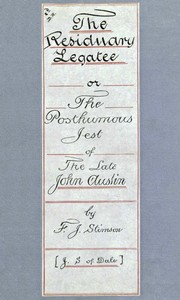
The Residuary Legatee; Or, The Posthumous Jest of the Late John Austin
Written by Frederic Jesup Stimson
Chaptra reads alongside you — AI insights, chapter breakdowns and reader discussions for every book. Join free
About this book
Reading guide
Themes, characters and key ideas in The Residuary Legatee; Or, The Posthumous Jest of the Late John Austin, written by Chaptra AI.
- about 8 hours
- intermediate
- romantic
- humorous
- mysterious
Frederic Jesup Stimson's "The Residuary Legatee" is a charming late 19th-century novel centered on Austin May, a bachelor who returns to his family estate in Brookline, Massachusetts, only to find his inheritance tied to a series of peculiar stipulations set forth in his late uncle's will. These eccentric conditions, a "posthumous jest" from John Austin, intricately complicate May's financial future and, more significantly, his romantic prospects, particularly with his cousin, May Austin, for whom he harbors unresolved feelings. As Austin navigates the legal labyrinth and the social expectations of his time, he embarks on a journey of self-discovery, wit, and unexpected romance. The narrative masterfully blends humor and intrigue, inviting readers into a world where love, legacy, and obligation are playfully intertwined.
“A man's legacy, it seems, can be as much a riddle as a fortune, and far more binding.”
Key themes
- Inheritance and Legacy
- The central theme, explored through the intricate and unconventional stipulations of John Austin's will. It delves into how wealth and family legacy can dictate individual choices, create obligations, and shape destinies, even from beyond the grave. It questions the true value of an inheritance beyond monetary gain.
- Love vs. Obligation
- This theme explores the conflict Austin May faces between following his heart (his feelings for May Austin) and fulfilling the conditions of his uncle's will, which imposes certain obligations on his romantic life. It highlights the societal pressures and personal dilemmas inherent in 19th-century courtship and marriage.
- The Nature of Wit and Jest
- The 'posthumous jest' of John Austin serves as a central motif, exploring the power of wit, humor, and even playful manipulation to influence lives. It questions whether such a jest is merely amusing or a profound, albeit unconventional, form of guidance and mentorship.
Worth discussing
How does John Austin's 'posthumous jest' serve as a catalyst for Austin May's personal growth and self-discovery?
Chapter-by-chapter breakdowns, character arcs and the full thematic analysis come with a free account.
Discussions
No one has started one yet
Questions this book opens up
No discussions yet
Be the first to start a discussion about this book!
Sign up to start the discussionReviews
No reviews yet
Be the first to review this book!