
About this book
Reading guide
Themes, characters and key ideas in The Republic of Plato, written by Chaptra AI.
- about 30 hours
- advanced
- philosophical
- analytical
- challenging
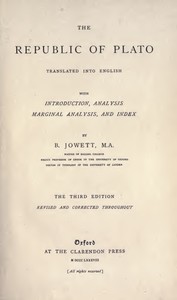
Plato's "The Republic" is a monumental philosophical dialogue that primarily explores the nature of justice, both in the individual soul and in the ideal state. Through the character of Socrates, Plato constructs a utopian society, Kallipolis, guided by reason and ruled by philosopher-kings, arguing that true justice leads to individual and societal well-being. The work delves into profound questions concerning ethics, political theory, education, and metaphysics, notably introducing the Theory of Forms and the Allegory of the Cave. It stands as a foundational text in Western thought, challenging readers to reconsider prevailing notions of morality and governance, and envisioning a society ordered by wisdom and virtue.
“Justice in the life and conduct of the state is possible only as first it resides in the hearts and souls of the citizens.”
Key themes
- Justice (Dikaiosyne)
- The central theme of the entire work, explored both as an individual virtue and as the organizing principle of an ideal state. Plato argues that justice is not merely adherence to laws or serving the powerful, but a harmonious ordering of the soul's parts (reason, spirit, appetite) and of society's classes (rulers, auxiliaries, producers), where each performs its proper function. True justice, he contends, leads to happiness and well-being.
- The Ideal State (Kallipolis)
- Plato's detailed blueprint for a utopian society, designed to embody perfect justice. It is characterized by a strict class structure (guardians, auxiliaries, producers), communal living for the upper classes, and rule by philosopher-kings. This state serves as a model against which existing political systems are measured and found wanting.
- The Theory of Forms
- Plato's metaphysical doctrine positing that beyond the observable, changing world of sensory experience, there exists a realm of perfect, eternal, and unchanging Forms (or Ideas). These Forms are the true reality, and physical objects are merely imperfect copies. Knowledge of these Forms, especially the Form of the Good, is essential for true wisdom and just governance.
Worth discussing
Is Plato's ideal state, Kallipolis, truly just, or is it a blueprint for totalitarianism? Discuss the strengths and weaknesses of its proposed structure.
Chapter-by-chapter breakdowns, character arcs and the full thematic analysis come with a free account.
Discussions
No one has started one yet
Questions this book opens up
No discussions yet
Be the first to start a discussion about this book!
Sign up to start the discussionReviews
No reviews yet
Be the first to review this book!