
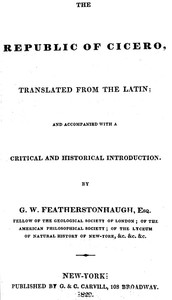
The republic of Cicero: Translated from the Latin; and Accompanied With a Critical and Historical Introduction.
Written by Marcus Tullius Cicero
Chaptra reads alongside you — AI insights, chapter breakdowns and reader discussions for every book. Join free
About this book
Reading guide
Themes, characters and key ideas in The republic of Cicero: Translated from the Latin; and Accompanied With a Critical and Historical Introduction., written by Chaptra AI.
- about 12 hours
- advanced
- philosophical
- didactic
- analytical
Cicero's "The Republic" is a profound philosophical treatise presented as a dialogue among prominent Roman figures, reflecting on the ideal form of governance for the Roman state. Written during a period of intense political turmoil in Rome, the work seeks to define and defend the concept of a true republic, emphasizing the necessity of justice, virtue, and civic duty for its preservation. Through the character of Scipio Africanus the Younger, Cicero explores various constitutional models, ultimately advocating for a mixed constitution that balances monarchical, aristocratic, and democratic elements. The text serves as a timeless meditation on the principles of legitimate authority, the common good, and the moral obligations of both leaders and citizens in maintaining a just society.
“"A commonwealth is the property of a people. But a people is not any collection of human beings brought together in any sort of way, but an assemblage of people in large numbers associated in respect of agreement on law and community of interest."”
Key themes
- Justice and the Ideal State
- The central theme of "The Republic" is the definition and defense of justice as the indispensable foundation of any legitimate state. Cicero argues that a true republic must be founded on an agreement on law and common interest, which inherently requires justice. He contrasts this with states based on tyranny or self-interest, which he deems illegitimate. The dialogue explores various forms of government in pursuit of the ideal, ultimately advocating for a mixed constitution that best embodies justice and stability.
- Virtue in Leadership and Citizenship
- Cicero strongly emphasizes that the success and longevity of a republic depend heavily on the virtue of its leaders and citizens. He argues that public service must be motivated by a commitment to the common good, selflessness, and moral integrity, rather than personal ambition or greed. The ideal statesman (*rector rei publicae*) is portrayed as a figure of exceptional wisdom, courage, and justice, whose primary duty is to guide the state towards stability and prosperity.
- The Mixed Constitution and Stability
- Building on Polybius, Cicero advocates for a mixed constitution as the most stable and just form of government. He argues that pure forms of government (monarchy, aristocracy, democracy) are inherently unstable and prone to cyclical degeneration. By combining elements of all three—monarchy (consuls), aristocracy (Senate), and democracy (popular assemblies)—a mixed constitution creates a system of checks and balances that prevents any one element from dominating and corrupting the state, thereby ensuring long-term stability and liberty.
Worth discussing
How does Cicero's definition of a 'republic' compare to modern understandings of democracy or republicanism?
Chapter-by-chapter breakdowns, character arcs and the full thematic analysis come with a free account.
Discussions
No one has started one yet
Questions this book opens up
No discussions yet
Be the first to start a discussion about this book!
Sign up to start the discussionReviews
No reviews yet
Be the first to review this book!