
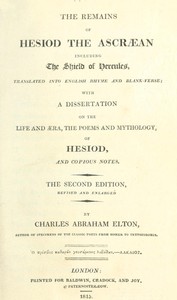
The Remains of Hesiod the Ascræan, Including the Shield of Hercules: Translated into English rhyme and blank verse; with a dissertation on the life and æra, the poems and mythology of Hesiod, and copious notes.
Written by Hesiod
Chaptra reads alongside you — AI insights, chapter breakdowns and reader discussions for every book. Join free
About this book
Reading guide
Themes, characters and key ideas in The Remains of Hesiod the Ascræan, Including the Shield of Hercules: Translated into English rhyme and blank verse; with a dissertation on the life and æra, the poems and mythology of Hesiod, and copious notes., written by Chaptra AI.
- about 25 hours
- advanced
- scholarly
- didactic
- epic
Charles Abraham Elton's early 19th-century work, "The Remains of Hesiod the Ascræan, Including the Shield of Hercules," serves as both a scholarly dissertation and a comprehensive translation of Hesiod's seminal ancient Greek poems. The volume meticulously explores Hesiod's life, historical era, and the intricate mythology embedded in his writings, such as those detailing agricultural wisdom, cosmic origins, and societal justice. Elton critically engages with previous translations, asserting the profound cultural and moral significance of Hesiod's works as reflections of ancient Greek thought. Through his detailed commentary and poetic translations, the book establishes Hesiod's legacy as a foundational voice in didactic poetry and a vital source for understanding the ancient Greek worldview.
“Most memorable and significant quotes would be drawn directly from Elton's translations of Hesiod's poems, such as moral injunctions from *Works and Days* on justice and labor, or epic descriptions from *Theogony* or *The Shield of Hercules*. Specific examples would require direct access to Elton's text, but generally embody Hesiod's didactic wisdom or mythological narratives.”
Key themes
- Justice and Moral Order
- Central to *Works and Days*, this theme explores the divine establishment of justice (Dike) among men, the consequences of injustice, and the importance of righteous conduct. Hesiod emphasizes that while animals live by force, humans are granted justice by Zeus, which is foundational for a stable society. Elton's analysis highlights how Hesiod uses myths, like the Five Ages of Man, to illustrate the decline from a golden age of justice to an iron age of strife.
- Labor and Diligence
- Prominently featured in *Works and Days*, this theme champions the virtue and necessity of hard work, particularly in agriculture. Hesiod argues that through diligent labor, humans can achieve prosperity and avoid poverty, which he views as a curse. The book contrasts honest toil with idleness and deceit, linking hard work to divine favor and personal dignity. Elton's commentary underscores this as a practical philosophy for living.
- Cosmogony and Theogony (Origins of Gods and the Universe)
- *Theogony* is entirely dedicated to this theme, providing a systematic account of the creation of the cosmos from Chaos and the birth and lineage of the Greek gods. It details the succession of divine rulers, from Uranus to Cronus to Zeus, and the various conflicts that shaped the Olympian pantheon. Elton’s translation and notes clarify the complex relationships and hierarchies within the Greek mythological framework.
Worth discussing
How does Elton's early 19th-century translation and commentary reflect the literary and scholarly sensibilities of his time?
Chapter-by-chapter breakdowns, character arcs and the full thematic analysis come with a free account.
Discussions
No one has started one yet
Questions this book opens up
No discussions yet
Be the first to start a discussion about this book!
Sign up to start the discussionReviews
No reviews yet
Be the first to review this book!