
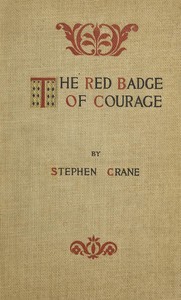
The Red Badge of Courage: An Episode of the American Civil War
Written by Stephen Crane
Chaptra reads alongside you — AI insights, chapter breakdowns and reader discussions for every book. Join free
About this book
Read it with a club
Chaptra's history and war clubs — small groups reading the same books and talking as they go.


Footnotes & Firefights
History and war
- 4 members
- 4 discussions
- Active Sep 11
Military history, from grand strategy down to the deeply boring logistics that actually decided everything. This is a Chaptra house club — set up and moderated by us to get the conversation going. Open to everyone; jump in anywhere.
Read The Red Badge of Courage: An Episode of the American Civil War alongside people who are reading it too.
Also here: Empire, Reconsidered
Chaptra Prime — paid clubs, every club feature, and unlimited reading support, for $5 a month or $60 once.
See PrimeReading guide
Themes, characters and key ideas in The Red Badge of Courage: An Episode of the American Civil War, written by Chaptra AI.
- about 8 hours
- intermediate
- gritty
- introspective
- anxious
Stephen Crane's "The Red Badge of Courage" is a seminal work of American naturalism, chronicling the psychological journey of Henry Fleming, a young Union soldier, during the American Civil War. The novel masterfully delves into Henry's internal conflict as he grapples with his romanticized notions of glory versus the stark, terrifying realities of combat. Through Henry's eyes, the narrative explores the fluid nature of courage and cowardice, the disorienting chaos of battle, and the profound impact of fear and self-preservation on the human psyche. Ultimately, it portrays his transformation from an insecure youth consumed by self-doubt into a more self-aware individual, having confronted his deepest fears and emerged with a newfound understanding of himself and the true meaning of heroism.
“He had but one desire, and that was to get an honorable wound. A serious wound, but not enough to kill him.”
Key themes
- Courage vs. Cowardice
- This is the central theme of the novel, explored not as a fixed moral quality but as a fluid, situational response to extreme pressure. Crane dissects Henry's internal struggle, showing how courage can be born of shame, animalistic instinct, or collective frenzy, rather than pure moral conviction. The 'red badge' itself becomes an ironic symbol of this ambiguity.
- The De-romanticization of War
- Crane strips away the traditional glory and heroism often associated with war, presenting it instead as a chaotic, brutal, and indifferent force. He focuses on the sensory overload, the psychological toll, and the sheer randomness of death, contrasting sharply with Henry's initial romantic illusions.
- Identity and Manhood
- Henry's journey is fundamentally a quest to define himself as a man, particularly in the context of war's ultimate test. He grapples with societal expectations of bravery and his personal fears, ultimately finding a more nuanced understanding of his own identity beyond simple labels of 'hero' or 'coward.'
Worth discussing
How does Crane challenge traditional notions of heroism and cowardice through Henry's experiences?
Chapter-by-chapter breakdowns, character arcs and the full thematic analysis come with a free account.
Discussions
No one has started one yet
Questions this book opens up
No discussions yet
Be the first to start a discussion about this book!
Sign up to start the discussionReviews
No reviews yet
Be the first to review this book!