
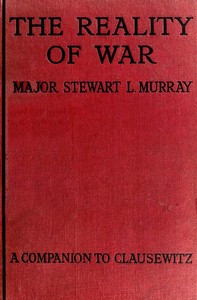
The Reality of War: A Companion to Clausewitz
Written by Stewart Lygon Murray
Chaptra reads alongside you — AI insights, chapter breakdowns and reader discussions for every book. Join free
About this book
Read it with a club
Chaptra's history and war clubs — small groups reading the same books and talking as they go.


Footnotes & Firefights
History and war
- 4 members
- 4 discussions
- Active 2d ago
Military history, from grand strategy down to the deeply boring logistics that actually decided everything. This is a Chaptra house club — set up and moderated by us to get the conversation going. Open to everyone; jump in anywhere.
Read The Reality of War: A Companion to Clausewitz alongside people who are reading it too.
Also here: Empire, Reconsidered
Chaptra Prime — paid clubs, every club feature, and unlimited reading support, for $5 a month or $60 once.
See PrimeReading guide
Themes, characters and key ideas in The Reality of War: A Companion to Clausewitz, written by Chaptra AI.
- about 8 hours
- intermediate
- Analytical
- Instructive
- Serious
Stewart Lygon Murray's "The Reality of War: A Companion to Clausewitz" is an early 20th-century military theory publication designed to demystify the complex ideas of Carl von Clausewitz. It serves as an accessible guide, distilling core principles of warfare, strategy, and the philosophical dimensions of military action for both military professionals and civilians. The book emphasizes Clausewitz's practical military background, showcasing how his experiences informed his seminal work, and critically underscores the enduring concept of war as a continuation of policy. Murray's work highlights the pervasive influence of Clausewitzian thought on modern military strategy, affirming its timeless relevance in understanding conflict. Through clear summaries and contextualization, it bridges the gap between the original, dense text and a broader audience seeking to grasp the fundamental nature of war.
“"War is not merely an act of policy, but a true political instrument, a continuation of political intercourse, carried on with other means."”
Key themes
- War as an Extension of Policy
- This is arguably the most central and enduring theme, positing that military action is not an end in itself but a tool wielded by political entities to achieve political objectives. Murray meticulously explains Clausewitz's famous dictum that war is 'a continuation of political intercourse with the admixture of other means.' This theme underscores the subservience of military strategy to state policy and the imperative for political aims to guide all military endeavors.
- The Nature of Warfare
- This theme explores the fundamental characteristics and inherent complexities of war itself. Murray elucidates Clausewitz's view of war not as a simple act of violence but as a multifaceted phenomenon driven by passion, shaped by chance, and ideally guided by reason. It covers concepts like 'absolute war' versus 'real war,' the 'fog of war,' and 'friction,' highlighting the unpredictable and human elements that define armed conflict.
- The Enduring Relevance of Clausewitz
- Murray explicitly addresses how Clausewitz's theories have transcended their original historical context to become timeless principles of military thought. This theme highlights the continuous influence of 'On War' on subsequent generations of military strategists, political leaders, and scholars. It underscores how Clausewitz's insights, despite being written in the 19th century, provide a framework for analyzing conflicts across different eras and technological landscapes.
Worth discussing
How does Murray's interpretation of Clausewitz emphasize the 'reality' of war, as opposed to purely theoretical constructs?
Chapter-by-chapter breakdowns, character arcs and the full thematic analysis come with a free account.
Discussions
No one has started one yet
Questions this book opens up
No discussions yet
Be the first to start a discussion about this book!
Sign up to start the discussionReviews
No reviews yet
Be the first to review this book!