
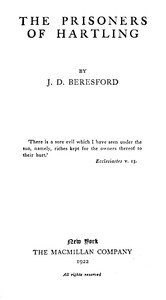
The Prisoners of Hartling
Written by J. D. (John Davys) Beresford
Chaptra reads alongside you — AI insights, chapter breakdowns and reader discussions for every book. Join free
About this book
Reading guide
Themes, characters and key ideas in The Prisoners of Hartling, written by Chaptra AI.
- about 8 hours
- intermediate
- introspective
- social commentary
- melancholy
J. D. Beresford's "The Prisoners of Hartling" introduces Arthur Woodroffe, a young general practitioner burdened by his demanding, unfulfilling work in a deprived neighborhood. Discontent and yearning for a more meaningful existence, Arthur's outlook shifts upon receiving an invitation to visit his affluent relatives at Hartling, who represent the luxurious life he envisions. The novel's opening establishes Arthur's internal conflict between material aspiration and the pursuit of genuine purpose, a tension shared in conversation with his colleague, Somers. This transition to Hartling sets the stage for a deep exploration of class disparities, personal fulfillment, and the subtle constraints that society and self impose, promising a journey of self-discovery and a critique of early 20th-century societal values.
“"The endless procession of ailments, the grim grey faces of the poor – it was a treadmill, and for what purpose?"”
Key themes
- Social Class and Aspiration
- The novel critically examines the rigid class structures of early 20th-century England and the aspirations of individuals to move beyond their assigned station. Arthur's discontent stems directly from his lower-middle-class professional life and his yearning for the wealth and ease represented by Hartling, highlighting the pervasive influence of social hierarchy on personal ambition and perceived happiness.
- Search for Purpose and Fulfillment
- Central to Arthur's character is his deep-seated dissatisfaction with his life, which he perceives as lacking 'deeper significance.' The novel explores the universal human quest for meaning beyond mere existence or professional obligation, questioning whether purpose is found in service, wealth, or self-discovery. Arthur's journey to Hartling is primarily a search for this elusive fulfillment.
- Societal Constraints vs. Individual Freedom
- The title itself, "The Prisoners of Hartling," suggests an exploration of various forms of confinement. Arthur feels imprisoned by his poverty and profession, while the wealthy relatives at Hartling may be trapped by their own social expectations, conventions, or the very trappings of their wealth. The novel examines how society's expectations, economic circumstances, and personal desires can limit an individual's true freedom.
Worth discussing
How does Arthur Woodroffe's initial discontent reflect broader societal anxieties of the early 20th century?
Chapter-by-chapter breakdowns, character arcs and the full thematic analysis come with a free account.
Discussions
No one has started one yet
Questions this book opens up
No discussions yet
Be the first to start a discussion about this book!
Sign up to start the discussionReviews
No reviews yet
Be the first to review this book!