
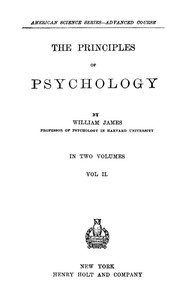
The Principles of Psychology, Volume 2 (of 2)
Written by William James
Chaptra reads alongside you — AI insights, chapter breakdowns and reader discussions for every book. Join free
About this book
Reading guide
Themes, characters and key ideas in The Principles of Psychology, Volume 2 (of 2), written by Chaptra AI.
- about 45 hours
- advanced
- analytical
- profound
- scholarly
William James's "The Principles of Psychology, Volume 2" completes his monumental exploration of the human mind, systematically dissecting complex mental phenomena from fundamental sensory experience to the intricacies of will and reason. This volume builds upon the first, moving beyond the 'stream of consciousness' to examine the specific faculties and operations of the mind, including sensation, perception, imagination, memory, reasoning, emotion, and volition. James masterfully integrates physiological insights with philosophical inquiry and introspective observation, presenting a comprehensive functionalist perspective on psychology. It remains a foundational text, influential for its rich prose, empirical rigor, and profound insights into the active, adaptive nature of the mind.
“Whilst part of what we perceive comes through our senses from the object before us, another part (and it may be the larger part) always comes out of our own head.”
Key themes
- Functionalism and Adaptation
- James consistently views mental processes not as isolated elements but as adaptive functions that help organisms interact with and survive in their environment. This theme is central to understanding how sensation, perception, emotion, and will all serve practical purposes in an organism's life.
- The Nature of Will and Free Will
- James dedicates significant attention to the concept of volition, exploring the mechanisms of choice, effort, inhibition, and the initiation of action. He grapples with the philosophical problem of free will versus determinism, presenting a nuanced view that acknowledges both physiological underpinnings and the subjective experience of conscious choice and moral responsibility.
- The Active and Selective Nature of Consciousness
- Building on Volume 1's 'stream of consciousness,' Volume 2 further elaborates on how consciousness is not a passive mirror of reality but an active, selective, and purposeful agent. This is evident in James's discussions of attention, perception, and reasoning, where the mind filters, organizes, and interprets information according to its own interests and needs.
Worth discussing
How does James's functionalist approach to psychology differ from earlier structuralist or associationist views, and what are its lasting implications?
Chapter-by-chapter breakdowns, character arcs and the full thematic analysis come with a free account.
Discussions
No one has started one yet
Questions this book opens up
No discussions yet
Be the first to start a discussion about this book!
Sign up to start the discussionReviews
No reviews yet
Be the first to review this book!