
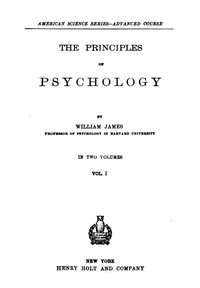
The Principles of Psychology, Volume 1 (of 2)
Written by William James
Chaptra reads alongside you — AI insights, chapter breakdowns and reader discussions for every book. Join free
About this book
Read it with a club
Small groups reading the same books and talking as they go.


News
- 4 members
- 1,813 discussions
- Active Sep 11
Read The Principles of Psychology, Volume 1 (of 2) alongside people who are reading it too.
Also here: News Bulletin, Just Joking....
Chaptra Prime — paid clubs, every club feature, and unlimited reading support, for $5 a month or $60 once.
See PrimeReading guide
Themes, characters and key ideas in The Principles of Psychology, Volume 1 (of 2), written by Chaptra AI.
- about 60 hours
- advanced
- Analytical
- Philosophical
- Groundbreaking
William James's "The Principles of Psychology, Volume 1" is a monumental late 19th-century scientific treatise that fundamentally reshaped the nascent field of psychology. It systematically explores mental processes, anchoring them firmly to their underlying physiological and cerebral conditions, moving beyond purely philosophical or spiritualistic explanations. James critiques prevailing theories like associationism and radical dualism, advocating for an empirical, natural science approach to understanding the mind. This volume lays the groundwork for a comprehensive understanding of consciousness, habit, emotion, and the mind-body relationship, establishing psychology as a rigorous academic discipline and introducing concepts like the 'stream of consciousness' that remain influential today.
“"The first fact for us, then, as psychologists, is that thinking of some sort goes on."”
Key themes
- Consciousness and Subjective Experience
- James's most famous contribution is his concept of the 'stream of consciousness,' which posits that consciousness is not a series of discrete states but a continuous, personal, ever-changing, and selective flow. He emphasizes its functional role in adapting to the environment and its inherently subjective nature, making it the central object of psychological inquiry, even while acknowledging its elusive qualities.
- The Mind-Body Problem
- James extensively explores the relationship between mental states and their underlying physical (cerebral) conditions. He rejects simplistic dualism and pure materialism, instead advocating for a functionalist perspective where mental processes are inextricably linked to brain activity, emphasizing their adaptive role. He seeks to bridge the gap between subjective experience and objective physiological reality without fully reducing one to the other.
- Empiricism and Scientific Methodology in Psychology
- James champions an empirical approach to psychology, advocating for observation, experimentation, and physiological understanding as the basis for the discipline. He systematically critiques purely metaphysical or introspective approaches that lack verifiable evidence, striving to establish psychology as a rigorous natural science akin to biology or physics, while still acknowledging the unique challenges of studying subjective experience.
Worth discussing
How does James's concept of the 'stream of consciousness' challenge earlier, more atomistic views of the mind? What are its implications for understanding subjective experience?
Chapter-by-chapter breakdowns, character arcs and the full thematic analysis come with a free account.
Discussions
No one has started one yet
Questions this book opens up
No discussions yet
Be the first to start a discussion about this book!
Sign up to start the discussionReviews
No reviews yet
Be the first to review this book!