
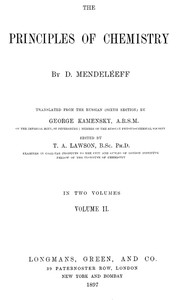
The Principles of Chemistry, Volume II
Written by Dmitry Ivanovich Mendeleyev
Chaptra reads alongside you — AI insights, chapter breakdowns and reader discussions for every book. Join free
About this book
Reading guide
Themes, characters and key ideas in The Principles of Chemistry, Volume II, written by Chaptra AI.
- about 20 hours
- advanced
- analytical
- foundational
- rigorous
Dmitry Ivanovich Mendeleyev's "The Principles of Chemistry, Volume II" is a seminal scientific treatise from the late 19th century that profoundly shaped the understanding of chemical elements. This volume meticulously details the periodic law, establishing a systematic framework for understanding the relationships between elements based on their atomic weights and properties. Mendeleyev emphasizes the critical role of empirical observation and quantitative data in discerning these fundamental chemical relationships. Through extensive discussion of concepts like isomorphism and crystalline forms, the book lays the groundwork for the modern periodic table, showcasing Mendeleyev's pioneering contributions to the field. It serves as a foundational text for advanced chemistry, demonstrating the power of systematic classification in scientific discovery.
“The periodic dependence of the composition and properties of elements on their atomic weights is a fundamental truth.”
Key themes
- The Periodic Law
- This is the central theme and discovery of the book, positing that the properties of elements are periodic functions of their atomic weights. Mendeleyev systematically demonstrates how this law provides a unifying framework for understanding chemical behavior and relationships, moving beyond mere descriptive chemistry to a predictive science.
- Empirical Observation and Quantitative Analysis
- Mendeleyev rigorously emphasizes that scientific understanding must be built upon careful observation and precise quantitative data. He uses experimental evidence, such as atomic weights, densities, and crystalline forms (isomorphism), to substantiate his theoretical claims, showcasing the scientific method in action.
- Prediction and Validation in Science
- A crucial aspect of Mendeleyev's work is not just explaining known phenomena but also predicting unknown ones. The periodic law's ability to accurately forecast the properties of undiscovered elements (e.g., gallium, germanium) served as powerful validation, elevating it from a hypothesis to a fundamental scientific law.
Worth discussing
How did Mendeleyev's emphasis on empirical data and quantitative analysis contribute to the scientific rigor of the periodic law?
Chapter-by-chapter breakdowns, character arcs and the full thematic analysis come with a free account.
Discussions
No one has started one yet
Questions this book opens up
No discussions yet
Be the first to start a discussion about this book!
Sign up to start the discussionReviews
No reviews yet
Be the first to review this book!