
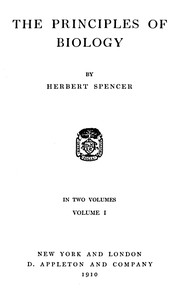
The Principles of Biology, Volume 1 (of 2)
Written by Herbert Spencer
Chaptra reads alongside you — AI insights, chapter breakdowns and reader discussions for every book. Join free
About this book
Reading guide
Themes, characters and key ideas in The Principles of Biology, Volume 1 (of 2), written by Chaptra AI.
- about 8 hours
- advanced
- Analytical
- Didactic
- Rigorous
Herbert Spencer's "The Principles of Biology, Volume 1" is a monumental late 19th-century scientific work that systematically lays out the foundational principles of biology through the pervasive lens of evolutionary theory. Spencer aims to distill general truths about living organisms, their development, and dynamic interaction with the environment, clarifying them with specific examples. The volume commences with a preface detailing the author's intent, the book's evolution, and the rapid progress in the biological field, emphasizing the synthesis of organic matter, forces, and life's surroundings. It introduces fundamental concepts like molecular mobility and chemical affinities, establishing a comprehensive, evolution-driven framework for understanding biological phenomena.
“Life, like the universe, is a process of continuous adjustment of internal relations to external relations.”
Key themes
- Evolutionary Theory
- This is the foundational principle through which Spencer interprets all biological phenomena. He views evolution not just as species change but as a universal law governing the development and organization of all living matter, from its simplest forms to its most complex interactions. It's the lens through which he seeks to unify biological knowledge.
- Development and Organization of Life
- Spencer meticulously explores how living organisms originate, grow, and become organized from fundamental organic matter. This theme delves into the processes by which life forms acquire their structure, function, and complexity, emphasizing the underlying physical and chemical principles (like molecular mobility and chemical affinities) that drive these developmental processes.
- The Search for General Truths (Systematic Philosophy)
- This theme reflects Spencer's overarching philosophical project: to synthesize all knowledge into a coherent, universal system based on evolutionary principles. In biology, this translates to an effort to move beyond specific observations to derive fundamental, overarching laws that govern all life, using "special truths" only to clarify these general principles.
Worth discussing
How does Spencer's "evolutionary lens" differ from or complement Darwin's theory of natural selection as presented in "On the Origin of Species"?
Chapter-by-chapter breakdowns, character arcs and the full thematic analysis come with a free account.
Discussions
No one has started one yet
Questions this book opens up
No discussions yet
Be the first to start a discussion about this book!
Sign up to start the discussionReviews
No reviews yet
Be the first to review this book!