
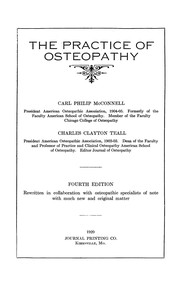
The practice of osteopathy
Written by Carl Philip McConnell,Charles Clayton Teall
Chaptra reads alongside you — AI insights, chapter breakdowns and reader discussions for every book. Join free
About this book
Reading guide
Themes, characters and key ideas in The practice of osteopathy, written by Chaptra AI.
- about 30 hours
- advanced
- instructive
- foundational
- analytical
"The Practice of Osteopathy" by McConnell and Teall is a seminal early 20th-century textbook that systematically outlines the foundational theory and practical application of osteopathic medicine. It introduces osteopathy's philosophy, tracing its origins to Andrew Taylor Still and emphasizing a holistic approach to health. The work thoroughly explains disease causation through structural lesions—malalignments in the musculoskeletal system—that impede the body's natural healing processes. It provides comprehensive instruction on diagnosis via meticulous physical examination and details manual correction techniques as primary interventions, distinguishing itself from conventional pharmaceutical or surgical methods. The book positions osteopathy as an integrative discipline rooted in anatomy, physiology, and the body's inherent capacity for self-regulation and healing.
“The body is a unit; the person is a unit of body, mind, and spirit.”
Key themes
- The Body's Self-Healing Capacity
- This is a cornerstone of osteopathic philosophy, asserting that the human body possesses inherent mechanisms for self-regulation, self-maintenance, and self-healing. The book consistently emphasizes that the role of the osteopath is not to 'cure' but to remove obstructions (lesions) that impede these natural restorative processes, allowing the body to heal itself. This theme challenges the then-prevailing medical paradigm of external intervention as the primary means of cure.
- Structure-Function Interrelationship
- A fundamental principle stating that the structure of the body (bones, muscles, ligaments, organs) and its function are reciprocally interrelated. The book meticulously details how structural integrity is essential for optimal physiological function, and conversely, how impaired function can lead to structural changes. This concept underpins the entire diagnostic and therapeutic approach of osteopathy.
- Holism and Integration
- The book promotes a holistic view of the patient, considering the individual as an integrated unit of body, mind, and spirit, rather than a collection of isolated symptoms or organ systems. It emphasizes that a problem in one area of the body can affect distant parts and overall health, necessitating a comprehensive assessment and treatment approach. This theme critiques the reductionist tendencies of conventional medicine.
Worth discussing
How does the historical context of early 20th-century medicine inform the revolutionary nature of osteopathic principles as presented in the book?
Chapter-by-chapter breakdowns, character arcs and the full thematic analysis come with a free account.
Discussions
No one has started one yet
Questions this book opens up
No discussions yet
Be the first to start a discussion about this book!
Sign up to start the discussionReviews
No reviews yet
Be the first to review this book!