
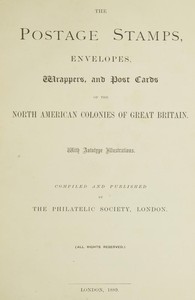
The postage stamps, envelopes, wrappers and post cards of the North American colonies of Great Britain
Written by Unknown author
Chaptra reads alongside you — AI insights, chapter breakdowns and reader discussions for every book. Join free
About this book
Reading guide
Themes, characters and key ideas in The postage stamps, envelopes, wrappers and post cards of the North American colonies of Great Britain, written by Chaptra AI.
- about 50 hours
- advanced
- Informative
- Detailed
- Historical
This book serves as a foundational philatelic catalog, meticulously documenting the postal emissions—stamps, envelopes, wrappers, and postcards—issued by the North American colonies under British rule. It provides a systematic and detailed record, crucial for collectors, historians, and researchers interested in the material culture of colonial communication. The work's primary aim is to identify, classify, and describe these historical artifacts, offering insights into their design, usage, and the administrative history behind them. It stands as an indispensable reference for understanding the evolution of postal services in pre-confederation North America.
“The systematic identification of colonial postal issues provides a tangible timeline of administrative evolution and inter-colonial communication.”
Key themes
- Colonial Postal History and Administration
- This book meticulously details the evolution of postal services within the British North American colonies, offering a tangible record of administrative decisions, technological advancements (in printing and paper), and the establishment of communication networks. It illustrates how postal systems were critical tools for imperial governance, economic development, and connecting geographically dispersed communities.
- Material Culture and Philatelic Classification
- The core of the book is its exhaustive classification and description of physical artifacts—stamps, envelopes, wrappers, and postcards. It demonstrates the rigorous methodology of philately, which involves detailed observation, categorization, and historical contextualization of these items. This theme emphasizes the transformation of everyday objects into historical documents and valuable collectibles through systematic study.
- Economic and Social History through Postal Rates
- By documenting the various denominations and types of postal emissions, the book implicitly sheds light on the economic realities and social interactions of the colonial period. Postal rates reflected the cost of transportation, the distance covered, and the economic capacity of the populace, offering insights into trade routes, economic development, and social stratification (e.g., differing rates for local vs. international mail).
Worth discussing
How do specialized catalogs like this contribute to our understanding of history beyond traditional historical narratives?
Chapter-by-chapter breakdowns, character arcs and the full thematic analysis come with a free account.
Discussions
No one has started one yet
Questions this book opens up
No discussions yet
Be the first to start a discussion about this book!
Sign up to start the discussionReviews
No reviews yet
Be the first to review this book!