
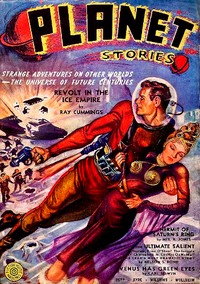
The Planet That Time Forgot
Written by Donald A. Wollheim
Chaptra reads alongside you — AI insights, chapter breakdowns and reader discussions for every book. Join free
About this book
Reading guide
Themes, characters and key ideas in The Planet That Time Forgot, written by Chaptra AI.
- about 8 hours
- intermediate
- mysterious
- adventurous
- thought-provoking
Donald A. Wollheim's "The Planet That Time Forgot" is an early 1940s science fiction novel that intricately weaves themes of time, perception, and interplanetary conflict. The narrative unfolds across two distinct storylines: the perilous struggle of Oomith, the noble leader of Toom, against the invading forces of the warlike Nimbor, led by Prince Aald, on a newly discovered Planet P. Simultaneously, an Earth crew journeys to this mysterious world, only to uncover that its inhabitants experience time at a vastly different, almost frozen, rate. The Earthmen, armed with advanced technology, find themselves compelled to intervene in the impending war, aiding Toom and unraveling the temporal enigma of Planet P, while grappling with questions of power, dignity, and the profound effects of time on civilization.
“"Time is not merely a river; it is a tapestry, and we, on this planet, are threads woven at a different speed."”
Key themes
- Time and Perception
- The central theme exploring how the relative flow of time fundamentally shapes existence, conflict, and understanding. The inhabitants of Planet P experience time at an incredibly accelerated rate, making their lives and conflicts appear 'frozen' to the Earthmen. This disparity forces a re-evaluation of reality.
- Interplanetary Conflict and Cultural Clash
- Explores the clash between two indigenous civilizations (Toom and Nimbor) and the broader cultural clash between the technologically advanced Earth crew and the comparatively primitive societies of Planet P. It examines the dynamics of conquest, resistance, and external influence.
- The Ethics of Intervention
- This theme questions the moral responsibilities and consequences when a technologically superior civilization encounters and chooses to interfere with a less developed one. It explores whether intervention, even with benevolent intentions, is truly justifiable.
Worth discussing
How does the concept of varied temporal perception challenge our understanding of reality, history, and progress?
Chapter-by-chapter breakdowns, character arcs and the full thematic analysis come with a free account.
Discussions
No one has started one yet
Questions this book opens up
No discussions yet
Be the first to start a discussion about this book!
Sign up to start the discussionReviews
No reviews yet
Be the first to review this book!