
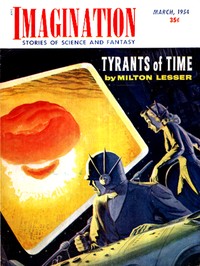
The Plagiarist From Rigel IV
Written by Evan Hunter
Chaptra reads alongside you — AI insights, chapter breakdowns and reader discussions for every book. Join free
About this book
Reading guide
Themes, characters and key ideas in The Plagiarist From Rigel IV, written by Chaptra AI.
- about 1 hours
- intermediate
- humorous
- mysterious
- thought-provoking
Evan Hunter's early 1950s science fiction short story, "The Plagiarist From Rigel IV," delves into the complex interplay of creativity, originality, and technological advancement through the unusual predicament of a struggling writer named Fred. He acquires a peculiar typewriter that spontaneously generates works by Edgar Allan Poe, revealing itself to be a sentient entity from the advanced planet Rigel IV. This leads to a humorous yet thought-provoking exploration of authorship as Fred grapples with his desire for original creation against the allure of easily accessible literary genius. Ultimately, Fred and the alien typewriter forge an unconventional partnership, trading stories that propel Fred to unexpected literary success, while simultaneously blurring the ethical lines of inspiration and blatant plagiarism.
“"Five dollars. For a typewriter. What's the catch?" (Fred, contemplating the pawn shop deal)”
Key themes
- Creativity vs. Originality
- The story profoundly questions the definition of creativity and the value of originality. It explores whether an act can be considered 'creative' if the source material is not entirely one's own, or if it is generated by an external, non-human entity. Fred's struggle between writing his 'own' stories and using the typewriter's output highlights this tension.
- Authorship and Plagiarism
- At its core, the story is a humorous yet tense exploration of the ethical boundaries of authorship and the act of plagiarism. It confronts the implications of claiming work that is not entirely one's own, even when that 'other' is an alien intelligence or a machine. Fred's internal conflict and eventual compromise highlight the gray areas in intellectual property.
- Technology and Art
- The narrative uses an advanced piece of alien technology (the typewriter) as a central element for artistic production, exploring the potential and perils of technology's involvement in the creative process. It examines how technology can both hinder and facilitate artistic output, ultimately serving as a partner or a replacement for human endeavor.
Worth discussing
How does 'The Plagiarist From Rigel IV' challenge our traditional definitions of authorship and originality?
Chapter-by-chapter breakdowns, character arcs and the full thematic analysis come with a free account.
Discussions
No one has started one yet
Questions this book opens up
No discussions yet
Be the first to start a discussion about this book!
Sign up to start the discussionReviews
No reviews yet
Be the first to review this book!