
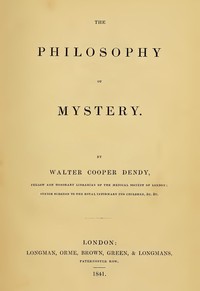
The Philosophy of Mystery
Written by Walter Cooper Dendy
Chaptra reads alongside you — AI insights, chapter breakdowns and reader discussions for every book. Join free
About this book
Reading guide
Themes, characters and key ideas in The Philosophy of Mystery, written by Chaptra AI.
- about 10 hours
- advanced
- mysterious
- philosophical
- historical
Walter Cooper Dendy's "The Philosophy of Mystery" is an early 19th-century philosophical treatise that delves into the nature and implications of the supernatural, particularly focusing on ghosts and spirits. Combining elements of philosophy, psychology, and historical anecdotes, the book explores the origins and persistence of belief in the spectral across different cultures and eras. It commences with a vivid scene on the Wye River, where a thoughtful bachelor, Astrophel, engages two young women in a dialogue about ghostly phenomena and the pursuit of wisdom concerning the unknown. This initial discussion sets a contemplative tone, reflecting a nuanced interplay of skepticism and curiosity regarding the existence of spirits and the philosophical boundaries between reality and illusion. Dendy's work serves as an intellectual exploration of mystery, human credulity, and the powerful narratives that shape our understanding of the unseen world.
“"The human mind, ever restless in its search for truth, often stumbles upon shadows it mistakes for substance, especially in the twilight realms of the unknown."”
Key themes
- The Nature of Belief and Skepticism
- This theme is central to Dendy's treatise, exploring the psychological and philosophical underpinnings of why humans believe in the supernatural, and conversely, why they doubt. The book delves into the interplay between personal experience, cultural narrative, and rational thought in forming one's stance on mysterious phenomena. It examines how credulity and critical thinking constantly vie for dominance in the human mind.
- Reality vs. Illusion
- Dendy continuously probes the boundaries between what is empirically real and what is perceived as real through illusion, imagination, or psychological states. This theme questions the reliability of human perception and the subjective nature of reality, especially when confronted with phenomena that defy conventional explanation. It explores how sensory deceptions, dreams, and mental conditions can create experiences interpreted as supernatural.
- The Power of Narrative and Imagination
- This theme examines how stories, legends, and the human capacity for imagination contribute to the creation and perpetuation of belief in the supernatural. Dendy explores the psychological appeal of mystery and the way narratives — whether passed down through generations or newly invented — shape our understanding of the world and our fears. It highlights how the human mind actively constructs meaning and reality, often filling gaps in knowledge with imaginative constructs.
Worth discussing
How does Dendy's early 19th-century perspective on the supernatural compare with contemporary scientific or psychological understandings?
Chapter-by-chapter breakdowns, character arcs and the full thematic analysis come with a free account.
Discussions
No one has started one yet
Questions this book opens up
No discussions yet
Be the first to start a discussion about this book!
Sign up to start the discussionReviews
No reviews yet
Be the first to review this book!