
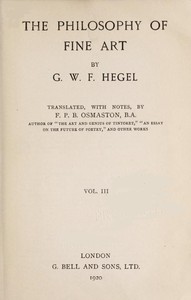
The Philosophy of Fine Art, volume 3 (of 4): Hegel's Aesthetik
Written by Georg Wilhelm Friedrich Hegel
Chaptra reads alongside you — AI insights, chapter breakdowns and reader discussions for every book. Join free
About this book
Read it with a club
Small groups reading the same books and talking as they go.


News
- 4 members
- 1,813 discussions
- Active Sep 11
Read The Philosophy of Fine Art, volume 3 (of 4): Hegel's Aesthetik alongside people who are reading it too.
Also here: News Bulletin, Just Joking....
Chaptra Prime — paid clubs, every club feature, and unlimited reading support, for $5 a month or $60 once.
See PrimeReading guide
Themes, characters and key ideas in The Philosophy of Fine Art, volume 3 (of 4): Hegel's Aesthetik, written by Chaptra AI.
- about 8 hours
- advanced
- philosophical
- analytical
- systematic
Hegel's *The Philosophy of Fine Art, Volume 3*, systematically analyzes the essence and evolution of artistic forms within his broader philosophical system. This volume delves into the nature and classification of specific arts like architecture, sculpture, and painting, establishing their historical development and philosophical significance. It explores the intricate relationship between art, beauty, the human spirit, and the material world, arguing that art serves as a crucial manifestation of the Absolute Idea. Hegel lays the groundwork for understanding how ideal concepts of beauty are realized in diverse artistic expressions, tracing art's progression from symbolic to classical and romantic forms. Ultimately, the volume illuminates art's role as a mode of spiritual truth, revealing the interplay between content and form as it evolves towards higher stages of self-comprehension.
“Beauty is the sensuous appearing of the Idea.”
Key themes
- The Ideal and the Material
- This central Hegelian theme explores the dialectical relationship between abstract, spiritual concepts (the Ideal) and their concrete, sensuous manifestations (the Material). In art, Hegel argues that beauty arises when the Ideal finds an adequate expression in a material form. The evolution of art forms, particularly within this volume, is seen as the Spirit's increasing success in shaping and permeating matter to reveal its own truth, moving from the crude symbolism of architecture to the harmonious embodiment in sculpture and the subjective inwardness of painting.
- The Evolution and Classification of Art Forms
- Hegel provides a teleological and systematic classification of art forms, viewing them not as discrete categories but as stages in the Spirit's self-unfolding. This volume focuses on the progression from symbolic art (represented by architecture), where the Idea is vague and the form disproportionate, to classical art (sculpture), where the Idea achieves a perfect, harmonious sensuous embodiment, and finally to romantic art (painting, and later music and poetry), where the Idea becomes more inward, subjective, and transcends its sensuous medium. This classification provides a historical and philosophical framework for understanding art's development.
- Beauty and Truth
- For Hegel, beauty is not merely a matter of subjective taste or aesthetic pleasure but is intimately linked to truth. Beautiful art, in his view, is that which successfully manifests the truth of the Absolute Idea in a sensuous form. The more perfectly the Idea is embodied and revealed through art, the more beautiful and significant the art is. This means that art is a mode of knowing, a way for humanity to apprehend spiritual truth. This volume demonstrates how different art forms achieve varying degrees of success in this manifestation, with classical sculpture representing a peak of objective beauty.
Worth discussing
How does Hegel's concept of 'Beauty as the sensuous appearing of the Idea' differ from more subjective or empirical definitions of beauty?
Chapter-by-chapter breakdowns, character arcs and the full thematic analysis come with a free account.
Discussions
No one has started one yet
Questions this book opens up
No discussions yet
Be the first to start a discussion about this book!
Sign up to start the discussionReviews
No reviews yet
Be the first to review this book!