
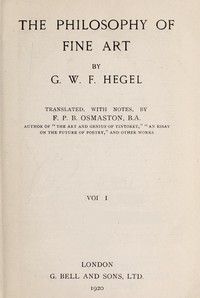
The Philosophy of Fine Art, volume 1 (of 4): Hegel's Aesthetik
Written by Georg Wilhelm Friedrich Hegel
Chaptra reads alongside you — AI insights, chapter breakdowns and reader discussions for every book. Join free
About this book
Read it with a club
Small groups reading the same books and talking as they go.


News
- 4 members
- 1,813 discussions
- Active Sep 11
Read The Philosophy of Fine Art, volume 1 (of 4): Hegel's Aesthetik alongside people who are reading it too.
Also here: News Bulletin, Just Joking....
Chaptra Prime — paid clubs, every club feature, and unlimited reading support, for $5 a month or $60 once.
See PrimeReading guide
Themes, characters and key ideas in The Philosophy of Fine Art, volume 1 (of 4): Hegel's Aesthetik, written by Chaptra AI.
- about 40 hours
- advanced
- Philosophical
- Profound
- Analytical
Georg Wilhelm Friedrich Hegel's "The Philosophy of Fine Art, Volume 1" is a foundational philosophical treatise from the early 19th century that systematically explores the nature, purpose, and significance of art. Rejecting the common perception of art as a mere decorative pastime, Hegel elevates it to a profound expression of human intellect and spirit, deserving of rigorous philosophical inquiry. He argues that the beauty found in art, being a creation of the human mind, holds a higher hierarchical position than natural beauty, serving as a manifestation of truth and the Absolute Idea. This inaugural volume lays the groundwork for his comprehensive aesthetic system, asserting art's crucial role in human experience and its capacity to reflect spiritual truths. Through this work, Hegel transforms the study of art into a serious scientific and philosophical discipline.
“The beauty of art is higher than nature.”
Key themes
- The Nature of Beauty
- Hegel fundamentally redefines beauty, distinguishing between natural beauty and artistic beauty. He argues that artistic beauty, being a product of human intellect and spirit, is inherently superior and more profound than natural beauty. While natural beauty is merely what *is*, artistic beauty is a conscious creation that reflects an idea, purpose, and spiritual content, making it a more elevated and significant form of beauty. This theme challenges traditional views that prioritize nature as the ultimate source of aesthetic value.
- Art as a Manifestation of Spirit and Truth
- A cornerstone of Hegel's aesthetics is the idea that art is not merely an imitation or a pastime, but a crucial medium through which the 'Absolute Spirit' or 'Idea' manifests itself in sensuous form. Art serves as a bridge between the purely sensuous world and the realm of pure thought, making spiritual truths accessible to human consciousness. For Hegel, art is a way for humanity to apprehend and express its deepest understanding of itself and the universe. It is a stage in the dialectical development of Spirit's self-knowledge.
- The Philosophical Significance of Art
- Hegel's primary aim in this volume is to establish art as a serious subject worthy of philosophical and scientific study, rejecting its dismissal as frivolous or merely decorative. He argues that the philosophical examination of art (aesthetics) is not a trivial pursuit but an essential component of understanding human culture, consciousness, and the unfolding of universal truth. By elevating art to this status, Hegel positions it as a vital pathway to knowledge, on par with religion and philosophy itself, albeit operating through sensuous intuition.
Worth discussing
How does Hegel's assertion of artistic beauty's superiority over natural beauty challenge or align with your own understanding of beauty?
Chapter-by-chapter breakdowns, character arcs and the full thematic analysis come with a free account.
Discussions
No one has started one yet
Questions this book opens up
No discussions yet
Be the first to start a discussion about this book!
Sign up to start the discussionReviews
No reviews yet
Be the first to review this book!