
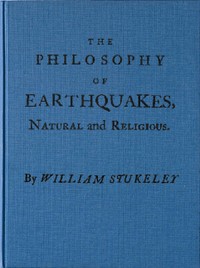
The Philosophy of Earthquakes, Natural and Religious: or, An Inquiry Into Their Cause, and Their Purpose
Written by William Stukeley
Chaptra reads alongside you — AI insights, chapter breakdowns and reader discussions for every book. Join free
About this book
Reading guide
Themes, characters and key ideas in The Philosophy of Earthquakes, Natural and Religious: or, An Inquiry Into Their Cause, and Their Purpose, written by Chaptra AI.
- about 10 hours
- advanced
- scholarly
- philosophical
- didactic
William Stukeley's "The Philosophy of Earthquakes, Natural and Religious" is a seminal 18th-century inquiry that meticulously examines earthquakes from both scientific and theological viewpoints. Prompted by an earthquake felt in London, Stukeley embarks on a quest to understand these phenomena not merely as physical occurrences but as events imbued with spiritual and moral significance. He challenges contemporary explanations, proposing electricity as a potential natural cause, while simultaneously interpreting earthquakes as divine warnings or judgments. The work blends detailed observation and historical accounts with philosophical speculation and a deep commitment to natural theology, urging readers to reflect on humanity's place in the cosmic order and the moral implications of natural disasters.
“The most dreadful phaenomena in nature are not without their use, and the wisdom and goodness of God are equally conspicuous in them, as in the most benevolent effects.”
Key themes
- Science and Religion / Natural Theology
- This is the central theme, exploring how Stukeley attempts to integrate scientific observations and hypotheses about earthquakes with a belief in divine providence and purpose. He sees natural laws as manifestations of God's design, and extraordinary events like earthquakes as both naturally caused and divinely intended warnings.
- Divine Judgment and Providence
- Stukeley frequently interprets earthquakes as direct or indirect manifestations of divine judgment or providential guidance. These events are not random but serve a moral purpose, urging humanity to reflect on its sins and mend its ways. This reflects a common theological viewpoint of the era, where natural disasters were often seen as God's warnings.
- The Nature of Causality and Explanation
- The book delves into the philosophical question of causality, exploring both immediate physical causes (like his electricity hypothesis) and ultimate metaphysical causes (God's will). Stukeley attempts to synthesize these, arguing that natural laws are merely the mechanisms through which divine will operates, blurring the lines between 'how' and 'why'.
Worth discussing
How does Stukeley attempt to reconcile scientific inquiry with theological belief? Is his synthesis successful from a modern perspective?
Chapter-by-chapter breakdowns, character arcs and the full thematic analysis come with a free account.
Discussions
No one has started one yet
Questions this book opens up
No discussions yet
Be the first to start a discussion about this book!
Sign up to start the discussionReviews
No reviews yet
Be the first to review this book!