
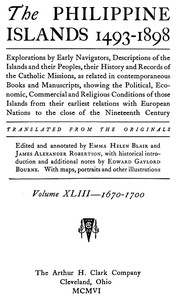
The Philippine Islands, 1493-1898, Volume 43, 1670-1700: Explorations by early navigators, descriptions of the islands and their peoples, their history and records of the Catholic missions, as related in contemporaneous books and manuscripts, showing the political, economic, commercial and religious conditions of those islands from their earliest relations with European nations to the close of the nineteenth century
Written by Unknown author
Chaptra reads alongside you — AI insights, chapter breakdowns and reader discussions for every book. Join free
About this book
Read it with a club
Small groups reading the same books and talking as they go.


News
- 4 members
- 1,813 discussions
- Active Sep 11
Read The Philippine Islands, 1493-1898, Volume 43, 1670-1700: Explorations by early navigators, descriptions of the islands and their peoples, their history and records of the Catholic missions, as related in contemporaneous books and manuscripts, showing the political, economic, commercial and religious conditions of those islands from their earliest relations with European nations to the close of the nineteenth century alongside people who are reading it too.
Also here: News Bulletin, Just Joking....
Chaptra Prime — paid clubs, every club feature, and unlimited reading support, for $5 a month or $60 once.
See PrimeReading guide
Themes, characters and key ideas in The Philippine Islands, 1493-1898, Volume 43, 1670-1700: Explorations by early navigators, descriptions of the islands and their peoples, their history and records of the Catholic missions, as related in contemporaneous books and manuscripts, showing the political, economic, commercial and religious conditions of those islands from their earliest relations with European nations to the close of the nineteenth century, written by Chaptra AI.
- about 30 hours
- advanced
- informative
- historical
- academic
Volume 43 of "The Philippine Islands, 1493-1898" covers the period from 1670 to 1700, serving as a meticulously compiled collection of contemporaneous documents related to the Spanish colonial presence in the Philippines. It presents a mosaic of primary sources, including official decrees, mission records, personal letters, and historical accounts, offering a multi-faceted view of the political, economic, commercial, and religious landscape of the archipelago during these three crucial decades. The volume provides invaluable insights into the daily operations of the colonial administration, the ongoing efforts of Catholic evangelization, and the complex interactions between Spanish colonizers and indigenous populations. It is an essential resource for scholars and historians seeking direct access to the raw materials of Philippine colonial history.
“"That the natives of these islands may be better instructed in our holy Catholic faith, and live in greater peace and quiet."”
Key themes
- Colonial Governance and Administration
- This theme explores the practicalities and challenges of Spanish rule in the Philippines. Documents detail the structure of colonial government, the responsibilities of the Governor-General, the role of the Audiencia, and the constant struggle to implement royal decrees across vast distances. It highlights issues of corruption, military defense, and resource management.
- Evangelization and Religious Conversion
- Central to the Spanish project, this theme examines the relentless efforts of Catholic religious orders to convert the indigenous population, establish churches, and suppress pre-colonial beliefs. Documents reveal the strategies employed, the successes achieved, the resistance encountered, and the frequent clashes between religious and civil authorities over jurisdiction and policy.
- Economic Exploitation and Trade
- This theme explores the economic underpinnings of the Spanish colony, primarily through the lens of the Manila Galleon trade, tribute systems, and resource extraction. Documents detail the flow of goods (especially silver from Mexico and silks from China), the collection of taxes from native populations, and the challenges of maintaining profitable trade routes while facing piracy and competition.
Worth discussing
How does the compilation of primary sources in this volume shape our understanding of 17th-century Philippine history compared to a single-authored historical narrative?
Chapter-by-chapter breakdowns, character arcs and the full thematic analysis come with a free account.
Discussions
No one has started one yet
Questions this book opens up
No discussions yet
Be the first to start a discussion about this book!
Sign up to start the discussionReviews
No reviews yet
Be the first to review this book!