
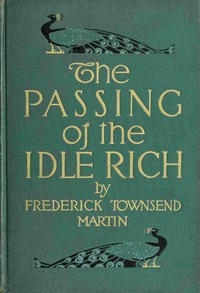
The Passing of the Idle Rich
Written by Frederick Townsend Martin
Chaptra reads alongside you — AI insights, chapter breakdowns and reader discussions for every book. Join free
About this book
Read it with a club
Small groups reading the same books and talking as they go.


News
- 1 member
- 1,813 discussions
- Active 1d ago
Read The Passing of the Idle Rich alongside people who are reading it too.
Also here: News Bulletin, Just Joking....
Chaptra Prime — paid clubs, every club feature, and unlimited reading support, for $5 a month or $60 once.
See PrimeReading guide
Themes, characters and key ideas in The Passing of the Idle Rich, written by Chaptra AI.
- about 8 hours
- intermediate
- analytical
- critical
- reflective
Frederick Townsend Martin's "The Passing of the Idle Rich" is a trenchant social critique from 1911, offering an insider's perspective on the perceived moral and societal decline of America's Gilded Age aristocracy. Martin, himself a scion of wealth, argues that the traditional role of inherited wealth and the 'idle rich' class is becoming obsolete, replaced by a new professional and industrious elite. He laments the irresponsibility, extravagance, and lack of purpose he observes among his peers, predicting a societal shift where mere inherited fortune without active contribution will no longer command respect or power. The book serves as both a nostalgic elegy for a dying social order and a prescient warning about the need for the wealthy to embrace social responsibility or face irrelevance.
“The American multi-millionaire, as a class, is a failure. He has not learned how to live, nor how to spend, nor how to die.”
Key themes
- The Obsolescence of Inherited Wealth
- Martin's core argument is that a class defined solely by inherited wealth, without contributing actively to society, is no longer viable or respected in modern America. He contrasts this with the historical function of European aristocracies, arguing that American inherited wealth lacks a legitimate social purpose and is therefore doomed to pass.
- Social Responsibility of the Wealthy
- A significant part of Martin's critique is directed at the lack of social responsibility among the idle rich. He argues that true wealth should come with a duty to contribute to the betterment of society, either through active work, philanthropy, or leadership, rather than mere self-indulgence.
- The Changing Nature of American Aristocracy
- Martin observes a fundamental shift in what constitutes 'aristocracy' in America. He argues that the old, inherited, and leisure-based definition is giving way to a new aristocracy based on merit, industry, and active contribution, often tied to professional and business success rather than lineage.
Worth discussing
How does Martin's insider perspective shape his critique of the 'idle rich'? What are the advantages and disadvantages of this viewpoint?
Chapter-by-chapter breakdowns, character arcs and the full thematic analysis come with a free account.
Discussions
No one has started one yet
Questions this book opens up
No discussions yet
Be the first to start a discussion about this book!
Sign up to start the discussionReviews
No reviews yet
Be the first to review this book!