
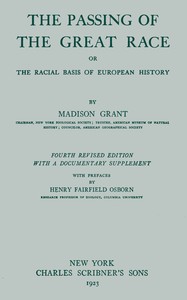
The passing of the great race; or, The racial basis of European history
Written by Madison Grant
Chaptra reads alongside you — AI insights, chapter breakdowns and reader discussions for every book. Join free
About this book
Reading guide
Themes, characters and key ideas in The passing of the great race; or, The racial basis of European history, written by Chaptra AI.
- about 12 hours
- advanced
- pseudoscientific
- polemical
- alarming
Madison Grant's "The Passing of the Great Race" is a foundational text of scientific racism and eugenics, published in the early 20th century. It posits that human history and societal development are primarily determined by immutable biological racial characteristics, rather than language or nationality. Grant argues for the inherent superiority of the "Nordic race" and warns against its dilution through immigration and racial mixing, advocating for eugenic policies to preserve racial purity. The book significantly influenced eugenics movements, immigration laws in the United States, and later, Nazi ideology, standing as a chilling testament to the dangers of pseudoscientific racial theories.
“The man who reads this book must be prepared to have some of his cherished beliefs shattered.”
Key themes
- Racial Hierarchy and Nordic Supremacy
- The central thesis of the book is the establishment of a rigid racial hierarchy, with the 'Nordic race' positioned as inherently superior in intelligence, leadership, and physical prowess, while Alpine and Mediterranean races are deemed lesser. Grant attributes all significant historical achievements to Nordic influence and warns of the dangers of its decline.
- Eugenics and Racial Purity
- Grant passionately advocates for eugenic policies, including strict immigration controls, anti-miscegenation laws, and selective breeding, to prevent the 'dilution' and 'degeneration' of the Nordic race. He views racial mixing as a grave threat to civilization and the future of humanity.
- Racial Determinism of History
- The book argues that racial heredity is the primary, if not sole, determinant of historical outcomes, societal structures, and individual capabilities, overriding the influence of environment, culture, language, or nationality. All historical progress and decline are interpreted through this biological lens.
Worth discussing
How did "scientific racism" like Grant's book gain such widespread acceptance in the early 20th century, and what does this reveal about the relationship between science, society, and ideology?
Chapter-by-chapter breakdowns, character arcs and the full thematic analysis come with a free account.
Discussions
No one has started one yet
Questions this book opens up
No discussions yet
Be the first to start a discussion about this book!
Sign up to start the discussionReviews
No reviews yet
Be the first to review this book!