
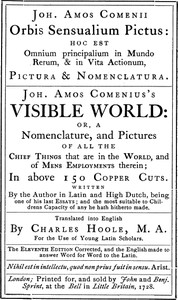
The Orbis Pictus
Written by Johann Amos Comenius
Chaptra reads alongside you — AI insights, chapter breakdowns and reader discussions for every book. Join free
About this book
Read it with a club
Chaptra's history and war clubs — small groups reading the same books and talking as they go.


Footnotes & Firefights
History and war
- 4 members
- 4 discussions
- Active Sep 11
Military history, from grand strategy down to the deeply boring logistics that actually decided everything. This is a Chaptra house club — set up and moderated by us to get the conversation going. Open to everyone; jump in anywhere.
Read The Orbis Pictus alongside people who are reading it too.
Also here: Empire, Reconsidered
Chaptra Prime — paid clubs, every club feature, and unlimited reading support, for $5 a month or $60 once.
See PrimeReading guide
Themes, characters and key ideas in The Orbis Pictus, written by Chaptra AI.
- about 4 hours
- beginner
- educational
- enlightening
- foundational
Johann Amos Comenius's "The Orbis Pictus" is a seminal 17th-century educational text, widely regarded as the first children's picture book. It pioneered an innovative approach to learning by combining detailed illustrations with corresponding names and descriptions in both Latin and the vernacular. Comenius championed sensory experience as the foundation of knowledge, structuring the book to introduce children to the world through visual and linguistic engagement. This revolutionary methodology aimed to make education delightful and accessible, significantly impacting early pedagogical practices. Its enduring legacy lies in demonstrating the power of visual aids and integrated language learning in childhood development.
“Knowledge begins with what can be perceived through the senses.”
Key themes
- Sensory Learning
- Comenius explicitly states that 'knowledge begins with what can be perceived through the senses.' This theme is central to the entire book, advocating for a direct, empirical approach to understanding the world. By presenting images alongside text, it grounds abstract concepts in tangible visual experiences, making learning more intuitive and effective for children.
- Visual Education
- The book's revolutionary use of illustrations is a testament to the power of visual aids in education. It posits that images are not merely decorative but fundamental tools for comprehension, especially for young learners. The integration of text and image facilitates understanding, memory retention, and engagement, making complex information more digestible.
- Bilingualism and Language Acquisition
- By presenting names and descriptions in both Latin and the vernacular (e.g., German, English), "The Orbis Pictus" actively promotes language learning and bilingualism. It serves as a vocabulary builder and a bridge between the classical scholarly language of Latin and the everyday language of the child, fostering a comprehensive linguistic foundation.
Worth discussing
How revolutionary was Comenius's concept of sensory learning in the 17th century, and how does it compare to modern educational theories?
Chapter-by-chapter breakdowns, character arcs and the full thematic analysis come with a free account.
Discussions
No one has started one yet
Questions this book opens up
No discussions yet
Be the first to start a discussion about this book!
Sign up to start the discussionReviews
No reviews yet
Be the first to review this book!