
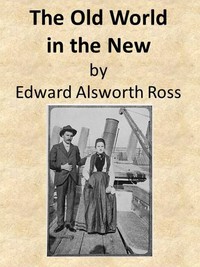
The Old World in the New: The Significance of Past and Present Immigration to the American People
Written by Edward Alsworth Ross
Chaptra reads alongside you — AI insights, chapter breakdowns and reader discussions for every book. Join free
About this book
Reading guide
Themes, characters and key ideas in The Old World in the New: The Significance of Past and Present Immigration to the American People, written by Chaptra AI.
- about 12 hours
- advanced
- Analytical
- Skeptical
- Concerned
Edward Alsworth Ross's "The Old World in the New" is an early 20th-century sociological examination of immigration's impact on American society. The book categorizes and analyzes various immigrant groups, tracing their perceived characteristics, contributions, and challenges to American identity and social cohesion. Ross moves beyond a purely humanitarian perspective, arguing for a nuanced view that considers both the benefits to immigrants and the potential consequences for the host nation. While acknowledging the transformative power of immigration in spreading democratic ideals, the work ultimately reflects a deep concern for maintaining established American standards and values in the face of diverse ethnic influxes, particularly from Southern and Eastern Europe. It serves as a significant historical document illustrating early sociological thought and prevalent nativist sentiments of its era.
“"The immigrant tide is not only a problem of people, but a problem of qualities."”
Key themes
- National Identity and 'American-ness'
- A foundational theme, Ross grapples with defining what constitutes 'American-ness' and how the continuous influx of diverse populations affects this identity. He expresses a strong concern that 'new' immigrants, particularly those from non-Anglo-Saxon backgrounds, possess characteristics (racial, cultural, political) that are fundamentally incompatible with American democratic ideals and social norms. This leads to a pervasive anxiety about the dilution or corruption of the 'American character' and institutions.
- Cultural Assimilation vs. Pluralism
- This theme is central, exploring the process by which immigrant groups integrate into American society. Ross largely advocates for assimilation, viewing it as essential for national unity, and expresses concern when groups retain distinct cultural practices. He often frames the retention of 'Old World' customs by 'new' immigrants as a challenge to American homogeneity and values, rather than as a form of cultural enrichment or pluralism.
- Race, Ethnicity, and Social Hierarchy
- This theme, though problematic, is fundamental to Ross's analysis. He operates from a framework of racial and ethnic hierarchy, often using pseudoscientific classifications to describe and evaluate different immigrant groups. Ross attributes inherent characteristics (intellectual capacity, moral fiber, industriousness) to various 'races,' frequently ranking them and suggesting that some are more desirable or assimilable than others. This underpins many of his concerns about the impact of 'new' immigration.
Worth discussing
How does Ross's distinction between 'old' and 'new' immigration reflect the racial and ethnic prejudices of his time?
Chapter-by-chapter breakdowns, character arcs and the full thematic analysis come with a free account.
Discussions
No one has started one yet
Questions this book opens up
No discussions yet
Be the first to start a discussion about this book!
Sign up to start the discussionReviews
No reviews yet
Be the first to review this book!