
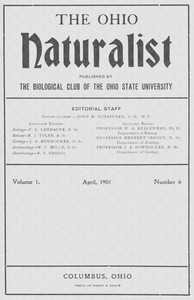
The Ohio naturalist, Vol. I, No. 6, April, 1901
Written by Ohio State University. Biological Club
Chaptra reads alongside you — AI insights, chapter breakdowns and reader discussions for every book. Join free
About this book
Read it with a club
Chaptra's history and war clubs — small groups reading the same books and talking as they go.


Footnotes & Firefights
History and war
- 4 members
- 4 discussions
- Active 2d ago
Military history, from grand strategy down to the deeply boring logistics that actually decided everything. This is a Chaptra house club — set up and moderated by us to get the conversation going. Open to everyone; jump in anywhere.
Read The Ohio naturalist, Vol. I, No. 6, April, 1901 alongside people who are reading it too.
Also here: Empire, Reconsidered
Chaptra Prime — paid clubs, every club feature, and unlimited reading support, for $5 a month or $60 once.
See PrimeReading guide
Themes, characters and key ideas in The Ohio naturalist, Vol. I, No. 6, April, 1901, written by Chaptra AI.
- about 8 hours
- advanced
- Informative
- Observational
- Academic
The Ohio Naturalist, Vol. I, No. 6, April, 1901, is a significant scientific publication edited by John H. Schaffner, produced by the Ohio State University Biological Club. This early 20th-century journal serves as a vital record of natural history research conducted in Ohio, particularly focusing on studies originating from the Lake Laboratory in Sandusky. It compiles a series of articles detailing ecological observations and research findings on the region's diverse flora and fauna, including specific investigations into plants like the Prickly Pear and the abundance of local dragonflies. The volume collectively emphasizes the ecological richness of Ohio's unique environments and underscores the importance of ongoing scientific study and documentation in understanding the state's natural heritage.
“Observations at the Lake Laboratory reveal a surprising abundance of *Anax junius* within the Sandusky marshlands.”
Key themes
- Ecological Observation and Documentation
- This theme is central to the journal, focusing on the systematic and detailed recording of natural phenomena. It encompasses the meticulous identification of species, the quantification of populations, and the description of habitats. The very existence of the journal is a testament to the importance placed on empirical observation as the foundation of scientific understanding.
- Biodiversity of Ohio
- The journal explicitly explores the rich variety of life found within Ohio's unique environments, particularly around Sandusky and the Lake Erie region. It highlights the specific flora and fauna that characterize the state, contributing to a comprehensive understanding of regional species distribution and ecological distinctiveness.
- Scientific Methodology and Fieldwork
- This theme implicitly highlights the practices and principles of scientific inquiry prevalent in the early 20th century. It showcases the importance of fieldwork, empirical data collection, and systematic analysis in advancing knowledge about the natural world. The articles demonstrate the practical application of scientific methods in ecological research.
Worth discussing
How do scientific journals like "The Ohio Naturalist" contribute to our understanding of historical ecological conditions?
Chapter-by-chapter breakdowns, character arcs and the full thematic analysis come with a free account.
Discussions
No one has started one yet
Questions this book opens up
No discussions yet
Be the first to start a discussion about this book!
Sign up to start the discussionReviews
No reviews yet
Be the first to review this book!