
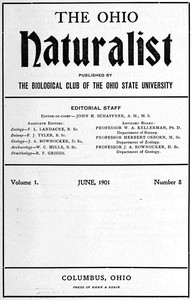
The Ohio naturalist, Vol. 1, No. 8, June 1901
Written by Ohio State University. Biological Club
Chaptra reads alongside you — AI insights, chapter breakdowns and reader discussions for every book. Join free
About this book
Read it with a club
Chaptra's history and war clubs — small groups reading the same books and talking as they go.


Footnotes & Firefights
History and war
- 4 members
- 4 discussions
- Active 2d ago
Military history, from grand strategy down to the deeply boring logistics that actually decided everything. This is a Chaptra house club — set up and moderated by us to get the conversation going. Open to everyone; jump in anywhere.
Read The Ohio naturalist, Vol. 1, No. 8, June 1901 alongside people who are reading it too.
Also here: Empire, Reconsidered
Chaptra Prime — paid clubs, every club feature, and unlimited reading support, for $5 a month or $60 once.
See PrimeReading guide
Themes, characters and key ideas in The Ohio naturalist, Vol. 1, No. 8, June 1901, written by Chaptra AI.
- about 4 hours
- advanced
- Informative
- Observational
- Academic
The Ohio Naturalist, Vol. 1, No. 8, June 1901, is a historical scientific periodical published by the Ohio State University Biological Club, serving as a vital record of early 20th-century natural history research. This specific issue compiles scientific papers, taxonomic descriptions, and ecological observations predominantly focused on the flora and fauna of Ohio and its surrounding regions. It provides a detailed snapshot of the scientific methodologies, interests, and knowledge base of naturalists during a pivotal era for biological sciences. The journal highlights meticulous empirical data collection and systematic species cataloging, contributing significantly to the regional understanding of biodiversity.
“The collection of fungi from this region presents several species heretofore unrecorded from Ohio, indicating a rich and diverse mycological flora.”
Key themes
- Biodiversity Documentation and Classification
- This theme is absolutely central to the journal's purpose, focusing on the systematic identification, meticulous description, and comprehensive cataloging of flora and fauna, particularly within the geographical confines of Ohio. Articles frequently present new species records, propose taxonomic revisions, or offer highly detailed morphological descriptions, reflecting the foundational work of naturalists in mapping and understanding the natural world.
- Empirical Observation and Scientific Methodology
- The journal strongly emphasizes direct empirical observation as the primary and most reliable method for generating scientific knowledge. Articles meticulously detail systematic field work, rigorous data collection protocols, and inductive reasoning processes employed to draw conclusions, thereby showcasing the prevailing scientific practices and standards of the early 20th century.
- The Role of Academic Institutions and Clubs in Science
- The journal itself is a direct product of the Ohio State University Biological Club, which serves as a compelling illustration of how academic institutions and specialized clubs fostered scientific inquiry, encouraged collaboration, and facilitated the dissemination of research among students and faculty at the turn of the century. It underscores the community aspect of early scientific endeavors.
Worth discussing
How do the scientific methodologies employed by naturalists in 1901 compare to contemporary biological research practices, particularly in field ecology and taxonomy?
Chapter-by-chapter breakdowns, character arcs and the full thematic analysis come with a free account.
Discussions
No one has started one yet
Questions this book opens up
No discussions yet
Be the first to start a discussion about this book!
Sign up to start the discussionReviews
No reviews yet
Be the first to review this book!