
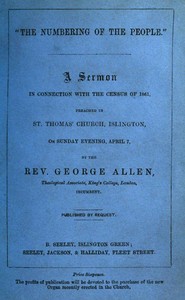
"The Numbering of the People": A Sermon in conjunction with the census of 1861 preached in St. Thomas' Church, Islington, on Sunday Evening, April 7
Written by George (Vicar of St. Thomas's Allen
Chaptra reads alongside you — AI insights, chapter breakdowns and reader discussions for every book. Join free
About this book
Reading guide
Themes, characters and key ideas in "The Numbering of the People": A Sermon in conjunction with the census of 1861 preached in St. Thomas' Church, Islington, on Sunday Evening, April 7, written by Chaptra AI.
- about 8 hours
- intermediate
- reflective
- admonitory
- serious
George Allen's "The Numbering of the People" is a compelling sermon delivered in 1861, leveraging the contemporary event of the national census to explore profound spiritual and civic duties. Allen masterfully connects the seemingly mundane act of population counting with deeper theological significance, urging his congregants to engage in both communal responsibility and intense personal introspection. The sermon emphasizes the Victorian era's dual focus on social order and spiritual accountability, framing the census as a divine call to reflect on one's relationship with God and fellow citizens. It culminates in a stark warning about an ultimate, divine reckoning, impelling listeners toward timely spiritual preparation and ethical living. This discourse serves as a powerful historical artifact, revealing the intertwining of faith and civic life in 19th-century Britain.
“The numbering of our earthly population serves but as a faint echo of that grander, eternal census which awaits us all before the Divine Judge.”
Key themes
- Spiritual Introspection and Accountability
- Allen uses the earthly census as a powerful metaphor for a personal, spiritual inventory. He urges congregants to engage in deep self-reflection, examining their relationship with God, their moral conduct, and their relationships with others. The sermon posits that accurate 'self-representation' before God is paramount, emphasizing personal accountability for one's actions and spiritual state as a preparation for eternal judgment.
- Civic Duty and Social Order
- The sermon explores the importance of the census as a tool for national welfare and governance, framing participation as a Christian duty. Allen argues that contributing to social order and understanding the population is not merely a bureaucratic task but a reflection of responsible citizenship, which is intrinsically linked to one's faith. He emphasizes that a well-ordered society allows for better care of its members and reflects divine providence.
- Divine Judgment and Eschatology
- A central and climactic theme is the inevitable 'divine reckoning of souls.' Allen uses the impending earthly census to foreshadow a greater, ultimate judgment by God. This theme serves as a powerful admonition, urging listeners to prepare their souls and make peace with God while they still can. It underscores the transient nature of earthly life and the eternal consequences of one's actions and spiritual state.
Worth discussing
How does Allen connect the secular act of a census with profound spiritual meaning? What are the implications of this connection for modern civic duties?
Chapter-by-chapter breakdowns, character arcs and the full thematic analysis come with a free account.
Discussions
No one has started one yet
Questions this book opens up
No discussions yet
Be the first to start a discussion about this book!
Sign up to start the discussionReviews
No reviews yet
Be the first to review this book!