
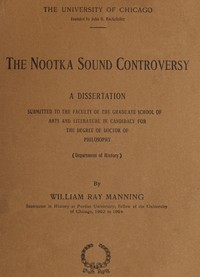
The Nootka Sound Controversy: A dissertation
Written by William R. (William Ray) Manning
Chaptra reads alongside you — AI insights, chapter breakdowns and reader discussions for every book. Join free
About this book
Reading guide
Themes, characters and key ideas in The Nootka Sound Controversy: A dissertation, written by Chaptra AI.
- about 12 hours
- advanced
- academic
- historical
- analytical
William R. Manning's "The Nootka Sound Controversy: A dissertation" offers a meticulous historical examination of the late 18th-century diplomatic dispute between England and Spain over Nootka Sound. Written in the early 20th century, this scholarly work challenges prior, often biased, interpretations by drawing on extensive archival research. Manning reconstructs the incident's origins within the context of the burgeoning fur trade and the competing colonial ambitions of European powers in the Pacific Northwest. He meticulously details the sequence of events, from initial discoveries to the confrontations and diplomatic miscalculations that escalated tensions, arguing for a more nuanced understanding of this seemingly minor territorial clash and its broader implications for international relations.
“The Nootka Sound Controversy, often relegated to a footnote, reveals the intricate web of imperial ambition and economic rivalry that defined late eighteenth-century international relations.”
Key themes
- Colonial Expansion and Imperial Rivalry
- This theme explores the relentless drive of European powers, particularly England and Spain, to expand their territories and spheres of influence across the globe. The Nootka Sound Controversy serves as a microcosm of this larger imperial competition, illustrating the clash between established claims and new assertions based on exploration and economic interest. Manning details how both nations viewed the Pacific Northwest as crucial for their geopolitical and commercial strategies.
- International Law and Sovereignty
- Manning's dissertation delves into the contested interpretations of international law governing territorial claims in the late 18th century. The controversy highlights the conflict between the principle of 'discovery' (favored by Spain for its long-standing claims) and 'effective occupation' (emphasized by England for its new commercial presence). The dispute forced a re-evaluation of what constituted legitimate sovereignty over newly explored or sparsely settled lands.
- Historiography and Bias
- A significant underlying theme in Manning's work is the critique of existing historical narratives. He explicitly aims to provide a 'more nuanced understanding' and challenge 'biased or simplistic' interpretations. This highlights the subjective nature of historical writing, particularly when influenced by nationalistic perspectives or limited access to sources, and underscores the importance of rigorous, archival research to uncover a more complete truth.
Worth discussing
How does Manning's work challenge or confirm your prior understanding of colonial expansion in the late 18th century?
Chapter-by-chapter breakdowns, character arcs and the full thematic analysis come with a free account.
Discussions
No one has started one yet
Questions this book opens up
No discussions yet
Be the first to start a discussion about this book!
Sign up to start the discussionReviews
No reviews yet
Be the first to review this book!