
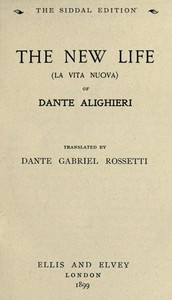
The New Life (La Vita Nuova)
Written by Dante Alighieri
Chaptra reads alongside you — AI insights, chapter breakdowns and reader discussions for every book. Join free
About this book
Reading guide
Themes, characters and key ideas in The New Life (La Vita Nuova), written by Chaptra AI.
- about 8 hours
- advanced
- romantic
- spiritual
- melancholy
“The New Life (La Vita Nuova)” is Dante Alighieri's seminal autobiographical prosimetrum, a unique blend of poetry and explanatory prose, chronicling his profound and transformative love for Beatrice Portinari. The work traces Dante's emotional and spiritual evolution, beginning with their childhood encounter and his immediate, idealized devotion. Through moments of intense joy, the pain of unrequited or misdirected affections, and particularly the profound grief following Beatrice's untimely death, Dante redefines the conventions of courtly love within the “Dolce Stil Novo” tradition. Ultimately, it serves as a lyrical testament to love's capacity to elevate the human soul, foreshadowing the grander spiritual epic of his later masterpiece, “The Divine Comedy.”
“Here begins the New Life.”
Key themes
- Courtly Love and Dolce Stil Novo
- “La Vita Nuova” is a foundational text for understanding the 'Dolce Stil Novo' ('Sweet New Style') school of poetry, which refined the conventions of courtly love. It explores a love that elevates the lover, making him better, more virtuous, and more capable of spiritual understanding. Beatrice is not just a beloved but a 'donna angelicata' (angelic woman) whose presence and virtue bring salvation and moral improvement to Dante.
- Spiritual Journey and Salvation
- The book charts Dante's progression from a secular, earthly love to a love that is explicitly tied to divine grace and salvation. Beatrice becomes a medium through whom Dante can approach God. Her death is not an end but a spiritual elevation, allowing her to serve as his guide to heaven, foreshadowing her crucial role in 'The Divine Comedy'. Love, in this context, becomes a path to spiritual enlightenment.
- Poetry and Inspiration
- “La Vita Nuova” is a meta-text, a reflection on the very act of writing poetry. Dante presents his poems as direct responses to his emotional and spiritual experiences with Beatrice, and the prose sections serve to contextualize, explain, and elaborate on the circumstances and intentions behind each poem. It is a testament to the power of art to process, articulate, and elevate human experience, demonstrating the poet's self-awareness and craft.
Worth discussing
How does Dante's concept of love in 'La Vita Nuova' differ from modern understandings of romantic love?
Chapter-by-chapter breakdowns, character arcs and the full thematic analysis come with a free account.
Discussions
No one has started one yet
Questions this book opens up
No discussions yet
Be the first to start a discussion about this book!
Sign up to start the discussionReviews
No reviews yet
Be the first to review this book!