
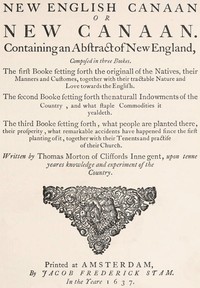
The New English Canaan of Thomas Morton with Introductory Matter and Notes
Written by Thomas Morton
Chaptra reads alongside you — AI insights, chapter breakdowns and reader discussions for every book. Join free
About this book
Read it with a club
Small groups reading the same books and talking as they go.


News
- 4 members
- 1,813 discussions
- Active Sep 11
Read The New English Canaan of Thomas Morton with Introductory Matter and Notes alongside people who are reading it too.
Also here: News Bulletin, Just Joking....
Chaptra Prime — paid clubs, every club feature, and unlimited reading support, for $5 a month or $60 once.
See PrimeReading guide
Themes, characters and key ideas in The New English Canaan of Thomas Morton with Introductory Matter and Notes, written by Chaptra AI.
- about 12 hours
- advanced
- historical
- polemical
- satirical
Thomas Morton's "The New English Canaan," edited by Charles Francis Adams, Jr., offers a unique and controversial counter-narrative to the dominant Puritan accounts of early New England. Documenting Morton's experiences at Merrymount, the text vividly portrays his communal, revelrous settlement and its stark contrast to the austere Plymouth Colony. It explores the clashes between differing colonial philosophies, Morton's surprisingly congenial relations with Native Americans, and his eventual persecution by Puritan authorities. This historical account serves as a vital primary source for understanding the diverse cultural landscape and ideological conflicts of 17th-century America, challenging conventional portrayals of the period.
“"The Separatists, who are Puritans of the worst sort, have no power to judge me."”
Key themes
- Cultural Clash and Ideological Conflict
- The central theme revolves around the fundamental differences in worldview, social norms, and religious practices between Morton's Merrymount settlement and the Puritan colonies. Morton's celebration of revelry, communal living, and trade-based economy stands in direct opposition to the Puritans' austere religious devotion, strict moral codes, and emphasis on spiritual salvation. This clash illustrates the diverse and often irreconcilable visions for early American society.
- Freedom vs. Authority/Conformity
- Morton's narrative is a plea for individual liberty and freedom from the rigid authority and conformity imposed by the Puritan leadership. He champions a life unburdened by strict religious dogma and social control, contrasting it with the oppressive environment of Plymouth. This theme explores the tension between personal autonomy and the demands of a collective, religiously-driven society.
- Perspective and Historical Revisionism
- The book itself is an act of historical revisionism, offering a counter-narrative to the dominant Puritan accounts of early colonial New England. Morton consciously challenges the official histories, presenting his version of events and characterizations of individuals like Governor Bradford. This theme highlights the subjective nature of historical truth and the importance of considering multiple perspectives to construct a comprehensive understanding of the past.
Worth discussing
How does Morton's account challenge or confirm your understanding of early American colonial history and the Puritan settlers?
Chapter-by-chapter breakdowns, character arcs and the full thematic analysis come with a free account.
Discussions
No one has started one yet
Questions this book opens up
No discussions yet
Be the first to start a discussion about this book!
Sign up to start the discussionReviews
No reviews yet
Be the first to review this book!