
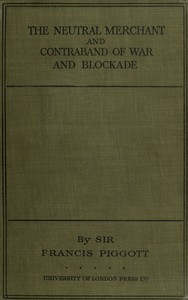
The neutral merchant: in relation to the law of contraband of war and blockade under the order in Council of 11th March, 1915
Written by Francis Taylor Piggott
Chaptra reads alongside you — AI insights, chapter breakdowns and reader discussions for every book. Join free
About this book
Reading guide
Themes, characters and key ideas in The neutral merchant: in relation to the law of contraband of war and blockade under the order in Council of 11th March, 1915, written by Chaptra AI.
- about 10 hours
- advanced
- Informative
- Analytical
- Legal
Francis Taylor Piggott's "The Neutral Merchant" is a seminal legal treatise from the early 20th century, dissecting the complex principles of international law concerning neutrality, contraband, and blockade amidst the backdrop of World War I. The work primarily scrutinizes the implications of the British Order in Council of March 1915, which aimed to counter German submarine warfare by restricting neutral trade benefiting the enemy. Piggott meticulously examines the legal and moral justifications for such belligerent actions, particularly in light of vigorous protests from neutral nations like the United States. His analysis delves into the delicate balance between national security interests, the rights and duties of neutral merchants, and the evolving framework of international law during wartime. The book thus serves as a critical historical document illuminating the intricate interplay of trade, law, and global power dynamics during a period of unprecedented conflict.
“The position of the neutral merchant in relation to the law of contraband of war and blockade is one of the most intricate and debated subjects in the whole range of international jurisprudence.”
Key themes
- Neutrality in Wartime
- This is the central theme, exploring the delicate balance and legal framework governing the conduct of neutral states and their citizens (merchants) during armed conflict. Piggott dissects the rights and duties of neutrals, the challenges they face from belligerent actions, and the evolving interpretations of what constitutes true neutrality in a globalized world.
- The Law of Contraband of War
- Piggott provides an exhaustive examination of contraband, classifying goods as 'absolute' (inherently military) or 'conditional' (military or civilian use depending on destination/intent). He explores how belligerents define and enforce contraband lists, and how this impacts neutral trade, particularly with the doctrine of continuous voyage.
- Blockade and Economic Warfare
- This theme delves into the legal principles and practical application of blockades, particularly the British response to German submarine warfare. Piggott analyzes the historical requirements for a legal blockade (effectiveness, notification) and how these were challenged or adapted by the realities of WWI, leading to a broader concept of economic warfare.
Worth discussing
How did the technological advancements of World War I (e.g., submarines) necessitate a re-evaluation of traditional international law concepts like blockade and contraband?
Chapter-by-chapter breakdowns, character arcs and the full thematic analysis come with a free account.
Discussions
No one has started one yet
Questions this book opens up
No discussions yet
Be the first to start a discussion about this book!
Sign up to start the discussionReviews
No reviews yet
Be the first to review this book!