
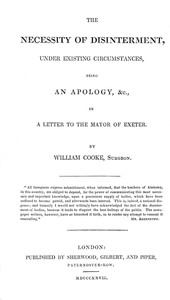
The necessity of disinterment, under existing circumstances
Written by William Cooke
Chaptra reads alongside you — AI insights, chapter breakdowns and reader discussions for every book. Join free
About this book
Read it with a club
Small groups reading the same books and talking as they go.


News
- 4 members
- 1,813 discussions
- Active Sep 11
Read The necessity of disinterment, under existing circumstances alongside people who are reading it too.
Also here: News Bulletin, Just Joking....
Chaptra Prime — paid clubs, every club feature, and unlimited reading support, for $5 a month or $60 once.
See PrimeReading guide
Themes, characters and key ideas in The necessity of disinterment, under existing circumstances, written by Chaptra AI.
- about 4 hours
- advanced
- apologetic
- polemic
- urgent
William Cooke's "The Necessity of Disinterment, under Existing Circumstances" is an early 19th-century medical treatise serving as a fervent defense of anatomical disinterment for educational purposes. Prompted by accusations against him for unlawful disinterment, Cooke articulates the crucial role of anatomy as the bedrock of medical science, arguing that the advancement of public health hinges on practical dissection. The text navigates the societal discomfort and legal strictures surrounding the acquisition of human bodies, advocating for a more understanding public perspective and proposing legal reforms to facilitate ethical access to unclaimed remains. Ultimately, Cooke's work is a polemic urging a utilitarian view, where the collective benefit of enhanced medical knowledge outweighs individual moral qualms about the means of acquisition.
“"The advancement of medical science, upon which the health and welfare of society depend, is inextricably linked to the practical study of human anatomy."”
Key themes
- The Necessity of Anatomical Study
- This is the core theme of Cooke's work. He argues unequivocally that practical anatomical dissection is the indispensable foundation of medical education and competent medical practice. Without it, surgeons and physicians would operate in ignorance, leading to preventable errors, suffering, and death. The theme is explored through logical argumentation, emphasizing the direct link between hands-on experience with human bodies and the development of skilled medical professionals.
- Science vs. Societal Morality
- Cooke grapples with the profound tension between the demands of scientific progress and deeply entrenched societal moral and religious objections. He argues that while public discomfort with disinterment is understandable, it must not be allowed to impede the advancement of a science vital for public welfare. The book explores the utilitarian argument that the greater good of society (through improved medical care) outweighs the moral discomfort of individuals regarding the treatment of the dead.
- Legal Reform and Public Policy
- A significant part of Cooke's argument is a call for legislative change. He identifies the existing legal framework as inadequate and counterproductive, forcing medical practitioners into illegal activities to obtain essential teaching materials. He advocates for public policy that would facilitate the legal acquisition of unclaimed bodies, thereby regularizing the practice and eliminating the need for disinterment. This theme highlights the interaction between law, ethics, and scientific necessity.
Worth discussing
To what extent do societal moral discomforts impede scientific or medical progress? Can these be ethically overcome?
Chapter-by-chapter breakdowns, character arcs and the full thematic analysis come with a free account.
Discussions
No one has started one yet
Questions this book opens up
No discussions yet
Be the first to start a discussion about this book!
Sign up to start the discussionReviews
No reviews yet
Be the first to review this book!