
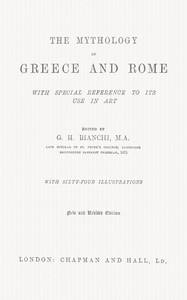
The mythology of Greece and Rome, with special reference to its use in art
Written by Otto Seemann
Chaptra reads alongside you — AI insights, chapter breakdowns and reader discussions for every book. Join free
About this book
Reading guide
Themes, characters and key ideas in The mythology of Greece and Rome, with special reference to its use in art, written by Chaptra AI.
- about 15 hours
- advanced
- Informative
- Academic
- Historical
Otto Seemann's "The Mythology of Greece and Rome," edited by G. H. Bianchi, is a late 19th-century academic treatise offering a comprehensive exploration of ancient Greek and Roman myths. The book delves into the intricate narratives of deities and heroes, tracing the origins and complexities of these stories. A central focus is placed on the profound influence of these myths on art, detailing how they have been represented and interpreted visually throughout history. Beyond mere storytelling, the text emphasizes the vital role of mythology in shaping cultural heritage, language, and moral understanding, presenting it as an essential key to appreciating classical art and thought.
“Myths are poetic narratives, rooted in ancient realities, which reflect human understanding of nature and divine powers.”
Key themes
- The Enduring Power of Myth
- This theme explores how ancient myths, despite their age, continue to hold profound relevance and influence across cultures and time. The book argues that myths are not merely historical curiosities but foundational narratives that shape human thought, language, moral understanding, and artistic expression. It emphasizes their capacity to convey universal truths about the human condition, nature, and the divine.
- The Interconnection of Myth and Art
- This is a core theme, explicitly stated in the book's title. It examines the symbiotic relationship between mythological narratives and their visual representation in art. The book argues that art not only illustrates myths but also interprets, perpetuates, and gives new life to them, making the understanding of one incomplete without the other. It explores how artistic mediums (sculpture, painting, architecture) serve as crucial vehicles for transmitting and interpreting mythological stories across generations.
- Cultural Heritage and Transmission
- The book positions Greek and Roman mythology as a fundamental component of Western cultural heritage, emphasizing its role in shaping the intellectual, artistic, and moral landscape of subsequent civilizations. It explores how these stories and their associated values have been transmitted, preserved, and reinterpreted through centuries, highlighting the importance of understanding this legacy for a complete grasp of cultural evolution.
Worth discussing
How does Seemann's late 19th-century perspective on mythology differ from contemporary understandings or interpretations?
Chapter-by-chapter breakdowns, character arcs and the full thematic analysis come with a free account.
Discussions
No one has started one yet
Questions this book opens up
No discussions yet
Be the first to start a discussion about this book!
Sign up to start the discussionReviews
No reviews yet
Be the first to review this book!