
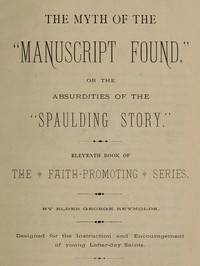
The Myth of the "Manuscript Found," or the Absurdities of the "Spaulding Story": Eleventh Book of the Faith-promoting Series. Designed for the Instruction and Encouragement of Young Latter-day Saints.
Written by Unknown author
Chaptra reads alongside you — AI insights, chapter breakdowns and reader discussions for every book. Join free
About this book
Reading guide
Themes, characters and key ideas in The Myth of the "Manuscript Found," or the Absurdities of the "Spaulding Story": Eleventh Book of the Faith-promoting Series. Designed for the Instruction and Encouragement of Young Latter-day Saints., written by Chaptra AI.
- about 8 hours
- intermediate
- Apologetic
- Didactic
- Assertive
This polemical work, the eleventh in a 'Faith-promoting Series,' serves as a robust apologetic defense against the 'Spaulding Story' or 'Manuscript Found' theory, which posited that the Book of Mormon was plagiarized from an unpublished historical romance by Solomon Spaulding. Aimed specifically at young Latter-day Saints, the book systematically dismantles the claims and purported evidence supporting the Spaulding theory, presenting it as an 'absurdity' designed to undermine faith. Through historical analysis, logical refutation, and an appeal to divine truth, it seeks to instruct and encourage its readers in the authenticity of their sacred texts and the foundational narratives of their faith. Ultimately, it reinforces the divine origin of the Book of Mormon, urging young believers to stand firm against external critiques.
“"The 'Manuscript Found' is a myth, a baseless fabrication designed solely to undermine the faith of the innocent."”
Key themes
- Truth vs. Error
- This is the foundational theme, framing the entire book as a battle between the divine truth of the Book of Mormon and the 'absurdities' and 'myths' of the Spaulding theory. The author systematically attempts to expose the latter as false and affirm the former as inherently true, using logical arguments and historical analysis.
- Defense of Religious Belief
- The book's overarching purpose is to provide a robust defense of Latter-day Saint beliefs against external criticism. It serves as an instruction manual for how to intellectually and spiritually withstand attacks on the foundational narratives of the faith, particularly for a young audience.
- Instruction and Encouragement of Youth
- Explicitly stated in the subtitle, this theme highlights the book's pedagogical intent. It aims to educate young Latter-day Saints about historical criticisms and provide them with the intellectual tools and spiritual reassurance necessary to navigate doubts and strengthen their commitment to the faith.
Worth discussing
How does this book attempt to reconcile faith with historical evidence and rational argument?
Chapter-by-chapter breakdowns, character arcs and the full thematic analysis come with a free account.
Discussions
No one has started one yet
Questions this book opens up
No discussions yet
Be the first to start a discussion about this book!
Sign up to start the discussionReviews
No reviews yet
Be the first to review this book!