
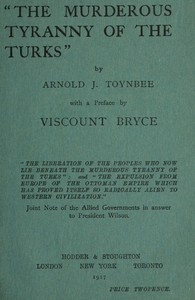
"The Murderous Tyranny of the Turks"
Written by Arnold Toynbee
Chaptra reads alongside you — AI insights, chapter breakdowns and reader discussions for every book. Join free
About this book
Reading guide
Themes, characters and key ideas in "The Murderous Tyranny of the Turks", written by Chaptra AI.
- about 8 hours
- advanced
- Sobering
- Outraged
- Historical
Arnold Toynbee's "The Murderous Tyranny of the Turks" is a fervent historical polemic written during World War I, aiming to expose the systematic oppression and atrocities committed by the Ottoman Empire, particularly under the Young Turks. The book details the suffering of various subjugated populations, primarily Armenians and Greeks, framing their persecution as a deliberate, genocidal policy driven by a nationalist agenda. Toynbee argues for the urgent necessity of dismantling Turkish rule in Europe, advocating for a post-war reorganization based on national self-determination and justice to prevent further destruction and suffering. It serves as both a historical account and a powerful call to action for the liberation of oppressed peoples.
“The story of Turkish rule in Europe is a story of murderous tyranny.”
Key themes
- Imperial Oppression and Misrule
- This is the central theme, arguing that Ottoman rule, particularly over its Christian subjects, was inherently oppressive, corrupt, and destructive. Toynbee details how the administration systematically denied rights, exploited resources, and maintained control through violence and intimidation, leading to centuries of suffering and underdevelopment in the subjugated territories.
- Genocide and Ethnic Cleansing
- The book meticulously documents the systematic extermination and forced displacement of ethnic and religious minorities, primarily Armenians, but also Greeks and Assyrians, by the Young Turk regime. Toynbee presents these actions not as random acts of violence but as a deliberate policy aimed at creating a homogenous Turkish state, making it one of the earliest comprehensive accounts of what would later be understood as genocide.
- National Self-Determination and Liberation
- Toynbee strongly advocates for the right of the oppressed peoples of the Ottoman Empire to govern themselves. He argues that the only just and lasting solution to the 'Turkish Question' is the liberation of these nations (Armenians, Greeks, etc.) and their establishment as independent states based on nationality, reflecting the prevailing liberal internationalist ideas of the post-WWI era.
Worth discussing
To what extent can a historical account also serve as a political polemic, and what are the implications for its objectivity and impact?
Chapter-by-chapter breakdowns, character arcs and the full thematic analysis come with a free account.
Discussions
No one has started one yet
Questions this book opens up
No discussions yet
Be the first to start a discussion about this book!
Sign up to start the discussionReviews
No reviews yet
Be the first to review this book!