
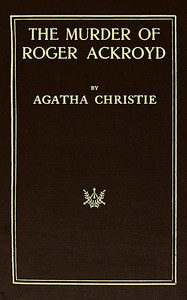
The murder of Roger Ackroyd
Written by Agatha Christie
Chaptra reads alongside you — AI insights, chapter breakdowns and reader discussions for every book. Join free
About this book
Read it with a club
Chaptra's mystery and crime clubs — small groups reading the same books and talking as they go.


Whodunit Wednesdays
Mystery and crime
- 4 members
- 4 discussions
- Active Sep 11
One mystery a fortnight. We stop at the reveal, everyone posts their accusation, and then we read on together. This is a Chaptra house club — set up and moderated by us to get the conversation going. Open to everyone; jump in anywhere.
Read The murder of Roger Ackroyd alongside people who are reading it too.
Chaptra Prime — paid clubs, every club feature, and unlimited reading support, for $5 a month or $60 once.
See PrimeReading guide
Themes, characters and key ideas in The murder of Roger Ackroyd, written by Chaptra AI.
- about 8 hours
- intermediate
- mysterious
- suspenseful
- clever
Agatha Christie's "The Murder of Roger Ackroyd" plunges readers into the seemingly tranquil village of King's Abbot, where the wealthy Roger Ackroyd is found murdered shortly after his lover, Mrs. Ferrars, dies under mysterious circumstances. Dr. James Sheppard, the local physician, becomes entangled in the investigation, collaborating with the eccentric Belgian detective Hercule Poirot, who has retired to the village. As Poirot meticulously sifts through a complex web of gossip, secrets, and red herrings among the various suspects, he uncovers a carefully constructed facade of lies. The narrative, told from Dr. Sheppard's perspective, culminates in one of the most shocking and celebrated twists in literary history, challenging the conventions of detective fiction and redefining the role of the narrator.
“"The truth, however ugly in itself, is always beautiful in its expression."”
Key themes
- Deception and Appearances vs. Reality
- This is the central theme, explored through the narrative's structure and the characters' actions. Almost every character harbors a secret or presents a false front, but the most profound deception is the narrator's own. The entire plot is built on the contrast between what appears to be true and the hidden, ugly reality.
- The Nature of Truth
- The novel meticulously dissects how truth is perceived, distorted, and ultimately revealed. Poirot's quest is not just to find a killer, but to uncover the 'little grey cells' of truth, piecing together fragments of information and psychological insights to reconstruct reality, often against the tide of convenient lies and misdirection.
- Justice and Morality
- The novel explores the boundaries of justice, particularly through Poirot's actions and the ultimate fate of Dr. Sheppard. Poirot, while dedicated to revealing the truth, sometimes allows for a 'gentleman's way out' for the guilty, raising questions about the letter versus the spirit of the law and personal accountability.
Worth discussing
How does the first-person narration by Dr. Sheppard manipulate the reader's trust and perception? What were your reactions upon discovering the twist?
Chapter-by-chapter breakdowns, character arcs and the full thematic analysis come with a free account.
Discussions
No one has started one yet
Questions this book opens up
No discussions yet
Be the first to start a discussion about this book!
Sign up to start the discussionReviews
No reviews yet
Be the first to review this book!