
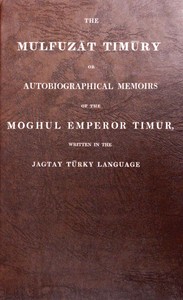
About this book
This work by Timur offers readers a unique literary experience. The narrative explores themes of timur, 1336-1405 and asia, central.
Reading guide
Themes, characters and key ideas in The Mulfuzāt Timūry = $b or, Autobiographical memoirs of the Moghul emperor Timūr, written by Chaptra AI.
- about 15 hours
- advanced
- epic
- historical
- authoritative
Timur's 'Mulfuzāt Timūry' is an extraordinary autobiographical account of the legendary Turco-Mongol conqueror, Tamerlane, offering a first-person perspective on his life, military campaigns, and philosophy of governance. Chronicling his rise from a minor noble to the founder of a vast empire, the memoirs detail his strategic genius, political machinations, and the brutal realities of 14th-century warfare across Central Asia, Persia, and parts of India and the Middle East. More than a mere chronicle of events, the work serves as Timur's self-fashioned legacy, presenting his justifications for conquest, his administrative principles, and his personal reflections on power, justice, and divine favor. It provides invaluable insight into the mindset of one of history's most formidable figures, blending historical narrative with a deeply personal, albeit biased, self-portrait of a world-shaping emperor.
“I was not a man of words but of deeds, and I never hesitated to draw the sword for the sake of justice and the advancement of the true faith.”
Key themes
- Conquest and Empire Building
- This is the overarching theme, detailing Timur's military campaigns, strategies, and the expansion of his empire across vast territories. The book explores the motivations behind his conquests, the logistical challenges, and the methods used to subdue and integrate diverse populations. It is a testament to his relentless ambition and military genius.
- Legacy and Self-Justification
- A significant aspect of the memoir is Timur's conscious effort to shape his own legacy. He presents himself as a just, pious, and divinely favored ruler, often rationalizing his brutal actions as necessary for stability or divinely ordained. This theme examines how powerful figures construct their narratives to influence historical perception.
- Leadership and Governance
- The memoirs offer significant insights into Timur's philosophy of leadership and his administrative principles. He details his methods for maintaining discipline in his army, organizing his vast territories, establishing legal codes, and managing diplomatic relations. This theme delves into the practicalities and ideals of governance from the perspective of an absolute monarch.
Worth discussing
How does Timur use religious justification to legitimize his conquests and rule?
Chapter-by-chapter breakdowns, character arcs and the full thematic analysis come with a free account.
Discussions
No one has started one yet
Questions this book opens up
No discussions yet
Be the first to start a discussion about this book!
Sign up to start the discussionReviews
No reviews yet
Be the first to review this book!