
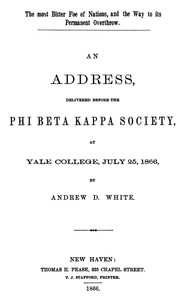
The Most Bitter Foe of Nations, and the Way to Its Permanent Overthrow
Written by Andrew Dickson White
Chaptra reads alongside you — AI insights, chapter breakdowns and reader discussions for every book. Join free
About this book
Reading guide
Themes, characters and key ideas in The Most Bitter Foe of Nations, and the Way to Its Permanent Overthrow, written by Chaptra AI.
- about 3 hours
- advanced
- serious
- didactic
- analytical
Andrew D. White's 1866 address, "The Most Bitter Foe of Nations," critically examines aristocracy as the primary impediment to national liberty and unity. White argues that systems of inherited privilege, rooted in oppression, consistently undermine political rights and social progress across various historical contexts. Through examples from Spain, Italy, Poland, and France, he illustrates how ruling minorities, driven by self-interest and a lack of moral integrity, foster disunity and tyranny. White advocates for the complete overthrow of such oppressive structures and, crucially, the full enfranchisement of the previously oppressed to prevent future regressions. His oration serves as a potent critique of political systems that prioritize minority interests over the fundamental rights of all citizens.
“The most bitter foe of nations is not a foreign power, but an aristocracy rooted in oppression, which, like a canker, consumes the heart of liberty.”
Key themes
- Aristocracy vs. Liberty
- This is the central theme, exploring the fundamental conflict between systems of inherited privilege and the principles of individual and national freedom. White argues that aristocracy inherently opposes liberty by concentrating power, stifling dissent, and preventing the broad distribution of rights necessary for a truly free society. He positions aristocracy not merely as an alternative political system but as the 'most bitter foe' of genuine liberty.
- Political Rights and Social Progress
- White strongly links the expansion of political rights to all citizens with a nation's ability to achieve social progress. He argues that denying rights to the oppressed classes not only perpetuates injustice but also actively hinders societal development, innovation, and unity. True progress, for White, is impossible without universal enfranchisement.
- Historical Patterns of Tyranny
- A significant part of White's analysis involves demonstrating how similar patterns of aristocratic oppression and subsequent national decline have recurred throughout history across different nations. He uses these historical examples to illustrate universal truths about power, human nature, and the fragility of liberty when confronted by entrenched privilege, making a strong case for learning from the past.
Worth discussing
How does White's definition of 'aristocracy' compare with modern understandings of elite power structures (e.g., economic oligarchies, political dynasties)?
Chapter-by-chapter breakdowns, character arcs and the full thematic analysis come with a free account.
Discussions
No one has started one yet
Questions this book opens up
No discussions yet
Be the first to start a discussion about this book!
Sign up to start the discussionReviews
No reviews yet
Be the first to review this book!