
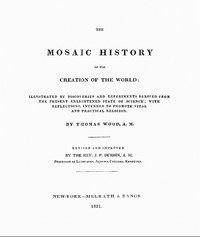
The Mosaic History of the Creation of the World: Illustrated by Discoveries and Experiments Derived from the Present Enlightened State of Science; With Reflections, Intended to Promote Vital and Practical Religion
Written by Thomas Wood
Chaptra reads alongside you — AI insights, chapter breakdowns and reader discussions for every book. Join free
About this book
Reading guide
Themes, characters and key ideas in The Mosaic History of the Creation of the World: Illustrated by Discoveries and Experiments Derived from the Present Enlightened State of Science; With Reflections, Intended to Promote Vital and Practical Religion, written by Chaptra AI.
- about 15 hours
- advanced
- Scholarly
- Reverent
- Didactic
Thomas Wood's "The Mosaic History of the Creation of the World" is an early 19th-century theological treatise that endeavors to harmonize the biblical account of creation with contemporary scientific discoveries. The work meticulously explores the attributes of God, including His self-existence and the concept of the Trinity, as revealed in Scripture, particularly through the divine name "Jehovah." Wood aims to demonstrate how scientific understanding can illuminate, rather than contradict, the Mosaic narrative, reinforcing the nature of God and His creative power. Ultimately, the book serves as an apologetic and devotional guide, encouraging readers to deepen their faith and practice vital religion through a comprehensive understanding of creation.
“The Mosaic account of creation, when illustrated by the present enlightened state of science, reveals with profound clarity the self-existence, goodness, and unified plurality of the Godhead.”
Key themes
- Reconciliation of Faith and Science
- This is the central driving force of the book. Wood attempts to demonstrate that the biblical account of creation is not only compatible with, but also illuminated and corroborated by, the scientific discoveries and experiments of his era. He views science as a tool to better understand God's work, not as a challenge to divine revelation, seeking to establish a harmonious relationship between empirical observation and theological truth.
- The Nature and Attributes of God
- Wood dedicates significant attention to establishing a robust theological understanding of God before delving into creation. He emphasizes God's self-existence, omnipotence, goodness, and particularly the complex doctrine of the Trinity, arguing that these foundational truths are essential for correctly interpreting the creation narrative and understanding the Creator's character. The creation itself is presented as a magnificent manifestation of these divine qualities.
- Divine Revelation and Interpretation of Scripture
- The book inherently explores how scripture (specifically Genesis) is to be understood, particularly when confronted with empirical observations. Wood advocates for an interpretation that allows for scientific insight to enrich, rather than undermine, the divine text, asserting the ultimate truth and authority of the Mosaic account as divine revelation. He demonstrates a method of exegesis that seeks harmony between the literal text and contemporary scientific understanding.
Worth discussing
How does Wood's approach to reconciling faith and science compare to contemporary debates on the same topic?
Chapter-by-chapter breakdowns, character arcs and the full thematic analysis come with a free account.
Discussions
No one has started one yet
Questions this book opens up
No discussions yet
Be the first to start a discussion about this book!
Sign up to start the discussionReviews
No reviews yet
Be the first to review this book!