
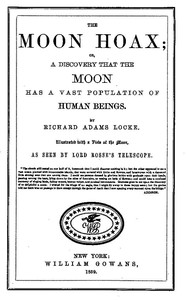
The Moon Hoax : $b Or, A Discovery that the Moon has a Vast Population of Human Beings
Written by Richard Adams Locke
Chaptra reads alongside you — AI insights, chapter breakdowns and reader discussions for every book. Join free
About this book
Reading guide
Themes, characters and key ideas in The Moon Hoax : $b Or, A Discovery that the Moon has a Vast Population of Human Beings, written by Chaptra AI.
- about 8 hours
- intermediate
- humorous
- satirical
- imaginative
Richard Adams Locke's "The Moon Hoax" is an early 19th-century satirical work presented as a genuine scientific report detailing incredible astronomical discoveries on the Moon. Fabricated under the guise of observations by the renowned Sir John Herschel, the narrative describes a vibrant lunar ecosystem teeming with diverse flora, fauna, and a population of intelligent, winged humanoids. This elaborate deception masterfully blends mock-scientific language with fantastical imagery, aiming to both entertain and critique the public's voracious appetite for sensational news and uncritical acceptance of scientific claims. It stands as a pivotal moment in the history of media manipulation and the emergence of science fiction.
“It has been justly remarked, that the subject of Astronomy is the most sublime that can engage the attention of a human being.”
Key themes
- Truth vs. Fiction / Media Manipulation
- This is the core theme of the hoax. Locke masterfully blurs the lines between verifiable fact and elaborate fabrication, demonstrating how easily a compelling narrative, especially one cloaked in scientific authority, can be mistaken for truth. It exposes the vulnerability of the public to sensationalism and the power of the press to construct reality, foreshadowing modern concerns about 'fake news.'
- Scientific Progress & Public Credulity
- The hoax plays on the era's fascination with scientific advancement and discovery, particularly in astronomy. It critiques both the public's uncritical acceptance of scientific claims, especially when they are sensational, and potentially the scientific community's own occasional hubris or desire for groundbreaking findings. The narrative's success relied on the public's readiness to believe in the seemingly infinite possibilities of science.
- Human Imagination & Exploration
- Beyond its satirical elements, "The Moon Hoax" is a testament to the boundless human imagination and the enduring desire to explore the unknown. Locke's vivid descriptions of lunar flora, fauna, and intelligent life tap into a deep-seated human curiosity about what lies beyond Earth, showcasing the power of narrative to transport readers to fantastical realms. It's an early example of speculative fiction's ability to envision other worlds.
Worth discussing
How did 'The Moon Hoax' exploit the scientific and journalistic climate of the 19th century to achieve its widespread success?
Chapter-by-chapter breakdowns, character arcs and the full thematic analysis come with a free account.
Discussions
No one has started one yet
Questions this book opens up
No discussions yet
Be the first to start a discussion about this book!
Sign up to start the discussionReviews
No reviews yet
Be the first to review this book!