
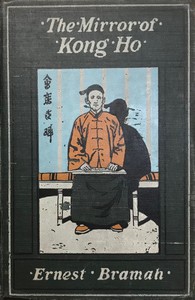
The Mirror of Kong Ho
Written by Ernest Bramah
Chaptra reads alongside you — AI insights, chapter breakdowns and reader discussions for every book. Join free
About this book
Reading guide
Themes, characters and key ideas in The Mirror of Kong Ho, written by Chaptra AI.
- about 8 hours
- intermediate
- humorous
- satirical
- observational
Ernest Bramah's "The Mirror of Kong Ho" is an early 20th-century epistolary novel that offers a witty and satirical critique of Western culture through the eyes of its Chinese protagonist, Kong Ho. Composed of letters written by Kong Ho during his sojourn in London, the book details his often-amused and sometimes bewildered observations of British society, customs, and inventions, which he frequently interprets as primitive or illogical. His cultural lens, which views Westerners as 'barbarians,' allows Bramah to humorously highlight the absurdities and contradictions of Edwardian England. The novel serves as a thoughtful exploration of cultural relativism, identity, and the nature of perception, making it both a comedic and intellectually stimulating read.
“Truly, these Western barbarians possess peculiar customs, which they themselves appear to hold in the highest esteem, despite their evident lack of logical foundation.”
Key themes
- Cultural Relativism and Clash
- This is the core theme of the novel, explored through Kong Ho's constant comparison of Western customs with his own Chinese traditions. The book systematically challenges the notion of universal 'civilization' by presenting Western behaviors as exotic, illogical, and often 'barbaric' from a different cultural vantage point. It highlights how deeply ingrained cultural norms shape perception and judgment.
- Satire of Western Society
- The entire premise of the novel is to satirize early 20th-century British society. Bramah uses Kong Ho's innocent yet sharp observations to expose the absurdities, contradictions, and unspoken rules of Western life, particularly its class structures, commercialism, technological hubris, and social conventions. The humor is often gentle but pointed, revealing the irrationality beneath the veneer of 'civilization'.
- Perception vs. Reality
- This theme explores how individual and cultural backgrounds profoundly shape what one perceives as 'reality.' Kong Ho's interpretations of Western life are consistently at odds with how Westerners themselves would describe their world, highlighting the subjective nature of truth and experience. The novel suggests that what one sees is heavily influenced by what one expects to see, or by the cultural framework through which one views the world.
Worth discussing
How does Bramah use Kong Ho's 'outsider' perspective to satirize Western society? What are the most effective examples?
Chapter-by-chapter breakdowns, character arcs and the full thematic analysis come with a free account.
Discussions
No one has started one yet
Questions this book opens up
No discussions yet
Be the first to start a discussion about this book!
Sign up to start the discussionReviews
No reviews yet
Be the first to review this book!