
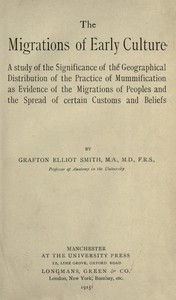
The migrations of early culture: A study of the significance of the geographical distribution of the practice of mummification as evidence of the migrations of peoples and the spread of certain customs and beliefs
Written by Grafton Elliot Smith
Chaptra reads alongside you — AI insights, chapter breakdowns and reader discussions for every book. Join free
About this book
Reading guide
Themes, characters and key ideas in The migrations of early culture: A study of the significance of the geographical distribution of the practice of mummification as evidence of the migrations of peoples and the spread of certain customs and beliefs, written by Chaptra AI.
- about 12 hours
- advanced
- informative
- academic
- analytical
Grafton Elliot Smith's "The Migrations of Early Culture" is an early 20th-century scientific treatise proposing a diffusionist view of ancient cultural development. The book meticulously examines the global distribution of mummification practices, along with megalithic structures, as primary evidence for widespread human migrations and the interconnectedness of early civilizations. Smith argues against the prevailing anthropological notion of independent invention, positing instead that complex cultural traits spread from a common origin, similar to contemporary cultural exchanges. His work aims to demonstrate a historical continuity and shared heritage among diverse peoples, challenging existing paradigms with a nuanced understanding of ancient global interactions. The text serves as a foundational argument for the diffusionist school of thought in anthropology.
“My initial intention was to compile evidence for a scientific society regarding the diffusion of knowledge and culture across ancient civilizations.”
Key themes
- Cultural Diffusion vs. Independent Invention
- This is the core thematic tension of the book. Smith directly argues against the prevailing anthropological notion that similar cultural practices (like mummification) arose independently in isolated societies. Instead, he champions the idea that complex cultural traits originated in one place and spread through migration and contact, emphasizing cultural transmission over spontaneous parallel development.
- Ancient Human Migration
- The book posits that the observed similarities in cultural practices are direct evidence of extensive and widespread migrations of peoples across continents in ancient times. Smith uses cultural traits as tracers, attempting to reconstruct the routes and patterns of these movements, thereby illustrating a more interconnected ancient world than previously imagined.
- The Significance of Mummification
- Mummification is presented not merely as a funerary custom but as a complex cultural 'package' encompassing specific techniques, beliefs about the afterlife, and social organization. Smith argues that its intricate and specific details, when found in geographically dispersed cultures, serve as irrefutable proof of cultural diffusion and interconnectedness, rather than independent invention.
Worth discussing
To what extent do you think complex cultural practices like mummification could arise independently in different societies?
Chapter-by-chapter breakdowns, character arcs and the full thematic analysis come with a free account.
Discussions
No one has started one yet
Questions this book opens up
No discussions yet
Be the first to start a discussion about this book!
Sign up to start the discussionReviews
No reviews yet
Be the first to review this book!