
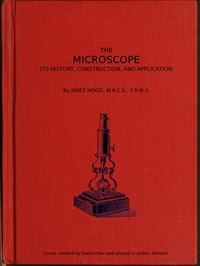
The Microscope. Its History, Construction, and Application 15th ed.: Being a familiar introduction to the use of the instrument, and the study of microscopical science
Written by Jabez Hogg
Chaptra reads alongside you — AI insights, chapter breakdowns and reader discussions for every book. Join free
About this book
Reading guide
Themes, characters and key ideas in The Microscope. Its History, Construction, and Application 15th ed.: Being a familiar introduction to the use of the instrument, and the study of microscopical science, written by Chaptra AI.
- about 12 hours
- intermediate
- informative
- educational
- historical
Jabez Hogg's "The Microscope. Its History, Construction, and Application, 15th ed." is a seminal late 19th-century scientific treatise offering a comprehensive introduction to microscopy. The work meticulously details the instrument's historical evolution, from its nascent forms to significant improvements, highlighting its transformative impact on medical and botanical studies. Aimed at both amateur enthusiasts and seasoned professionals, Hogg's text serves as an educational guide, demystifying complex optical principles and technical specifications. Through his enthusiastic prose, Hogg endeavors to cultivate a widespread appreciation for the "fascinating study" of the microscopic world, firmly establishing the microscope as an indispensable tool for scientific inquiry and public education.
“From a mere curiosity, the microscope has risen to an instrument of indispensable utility, revealing worlds previously unimaginable to the human eye.”
Key themes
- The Pursuit of Scientific Knowledge
- This theme is central to the entire work, as the microscope itself is presented as a primary tool for expanding human knowledge beyond the limits of natural perception. Hogg emphasizes how the instrument has unveiled previously invisible worlds, leading to groundbreaking discoveries in biology, medicine, and other fields. The book implicitly argues for the value of empirical observation and continuous inquiry as fundamental to scientific progress and human understanding.
- Technological Innovation and Progress
- Hogg meticulously traces the historical evolution of the microscope, highlighting the incremental and revolutionary improvements made by various scientists and instrument makers over centuries. This underscores the theme that scientific progress is often intertwined with, and dependent upon, technological innovation. The book celebrates human ingenuity in overcoming optical and mechanical challenges to refine the instrument, demonstrating how better tools lead to deeper understanding.
- Accessibility of Science and Education
- A core stated purpose of Hogg's work is to serve as a 'familiar introduction' aimed at 'both amateur enthusiasts and professionals.' This highlights the theme of democratizing scientific knowledge, making complex subjects understandable and engaging for a broad audience. Hogg's enthusiastic and clear explanations are designed to inspire and educate, fostering a wider public engagement with science and encouraging self-improvement through scientific literacy, a key Victorian ideal.
Worth discussing
How did the popularization of scientific instruments like the microscope impact public engagement with science in the Victorian era?
Chapter-by-chapter breakdowns, character arcs and the full thematic analysis come with a free account.
Discussions
No one has started one yet
Questions this book opens up
No discussions yet
Be the first to start a discussion about this book!
Sign up to start the discussionReviews
No reviews yet
Be the first to review this book!