
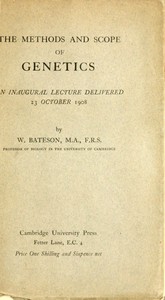
The Methods and Scope of Genetics: An inaugural lecture delivered 23 October 1908
Written by William Bateson
Chaptra reads alongside you — AI insights, chapter breakdowns and reader discussions for every book. Join free
About this book
Reading guide
Themes, characters and key ideas in The Methods and Scope of Genetics: An inaugural lecture delivered 23 October 1908, written by Chaptra AI.
- about 3 hours
- intermediate
- informative
- foundational
- analytical
William Bateson's "The Methods and Scope of Genetics" is a seminal 1908 inaugural lecture that formally introduces the nascent field of genetics, emphasizing Mendelian principles of heredity and variation. It elucidates how traits pass from parents to offspring through gametes, detailing phenomena like segregation using accessible analogies involving plants and animals. Bateson stresses the structured transmission of genetic information and its influence on development, arguing for genetics' profound implications. The lecture highlights its critical role in advancing agriculture, medicine, and human understanding, establishing genetics as an indispensable science in the early 20th century.
“The fundamental principles of heredity, long shrouded in mystery, have now been revealed through the simple yet profound work of Mendel.”
Key themes
- Heredity and Variation
- This is the core scientific theme, exploring how traits are passed down from parents to offspring and the mechanisms that lead to differences between individuals. Bateson explains Mendelian principles like segregation as the fundamental laws governing these processes, emphasizing the discrete nature of inherited characteristics.
- Societal Impact and Application of Science
- Bateson strongly emphasizes that understanding genetics is not merely an academic exercise but has profound practical implications for improving human society. This theme explores the transformative potential of scientific knowledge when applied to real-world problems and challenges.
- The Scientific Method and Discovery
- Bateson's lecture implicitly champions the power of empirical observation and experimentation (specifically Mendel's work) to uncover fundamental biological laws. It highlights the process of scientific inquiry, the rediscovery of crucial knowledge, and the establishment of a new, rigorous scientific discipline.
Worth discussing
How did Bateson's lecture contribute to establishing genetics as a legitimate and distinct scientific field in the early 20th century?
Chapter-by-chapter breakdowns, character arcs and the full thematic analysis come with a free account.
Discussions
No one has started one yet
Questions this book opens up
No discussions yet
Be the first to start a discussion about this book!
Sign up to start the discussionReviews
No reviews yet
Be the first to review this book!