
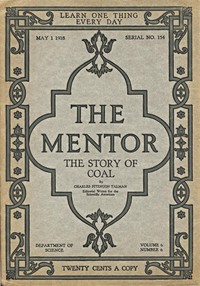
The Mentor: The Story of Coal, vol. 6, Num. 6, Serial No. 154, May 1, 1918
Written by Charles Fitzhugh Talman
Chaptra reads alongside you — AI insights, chapter breakdowns and reader discussions for every book. Join free
About this book
Reading guide
Themes, characters and key ideas in The Mentor: The Story of Coal, vol. 6, Num. 6, Serial No. 154, May 1, 1918, written by Chaptra AI.
- about 8 hours
- intermediate
- Informative
- Didactic
- Analytical
Charles Fitzhugh Talman's "The Mentor: The Story of Coal" is a comprehensive early 20th-century educational publication, offering readers a detailed exploration of coal's geological origins, industrial significance, and societal implications. Published in 1918 as part of the didactic Mentor series, this volume systematically covers coal's formation from ancient vegetation, outlines major U.S. coal fields, and traces the evolution of mining practices. Beyond its practical uses in generating electricity and industrial chemicals, Talman also addresses critical issues of the era, including air pollution, mine safety, and the nascent concept of resource sustainability. Through informative prose and illustrations, the book serves as a vital historical document, showcasing coal's indispensable role in powering modern industrialization and energy use during a pivotal period.
“From the verdant swamps of the Carboniferous Period, nature forged the black diamonds that now power our civilization.”
Key themes
- Industrialization and Progress
- This theme explores how coal served as the fundamental energy source driving the Second Industrial Revolution. It details how coal's widespread availability and energy density fueled factories, powered transportation, and enabled the electrification of cities, thereby transforming economies and societies. The book implicitly celebrates human ingenuity in harnessing this resource to achieve unprecedented technological advancement and economic growth.
- Resource Management and Sustainability
- Despite coal's perceived abundance in 1918, Talman's inclusion of 'the future sustainability of coal resources' signifies an early, albeit nascent, awareness of finite resources. This theme highlights the emerging consciousness that even seemingly inexhaustible natural resources require thoughtful management and consideration for future generations. It reflects an initial step towards understanding the long-term implications of large-scale resource extraction.
- Environmental and Social Costs of Progress
- Even in an era largely focused on industrial expansion, the book acknowledges the negative externalities associated with coal use. This theme explores the recognition of challenges such as 'air pollution from coal combustion' and 'safety concerns within coal mines.' It demonstrates an early understanding that industrial progress, while beneficial, comes with significant human and environmental costs that require attention and mitigation.
Worth discussing
How has our understanding and reliance on coal changed since 1918, and what factors contributed to these shifts?
Chapter-by-chapter breakdowns, character arcs and the full thematic analysis come with a free account.
Discussions
No one has started one yet
Questions this book opens up
No discussions yet
Be the first to start a discussion about this book!
Sign up to start the discussionReviews
No reviews yet
Be the first to review this book!