
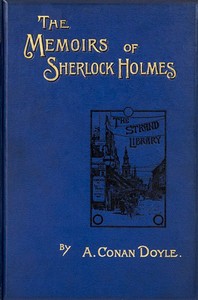
The Memoirs of Sherlock Holmes
Written by Arthur Conan Doyle
Chaptra reads alongside you — AI insights, chapter breakdowns and reader discussions for every book. Join free
About this book
Reading guide
Themes, characters and key ideas in The Memoirs of Sherlock Holmes, written by Chaptra AI.
- about 9 hours
- intermediate
- mysterious
- intellectual
- suspenseful
Arthur Conan Doyle's "The Memoirs of Sherlock Holmes" is a pivotal collection of eleven detective stories that further cement the legendary status of Sherlock Holmes and Dr. John Watson. Set against the richly depicted backdrop of late Victorian London and its surrounding countryside, the book showcases Holmes's unparalleled powers of observation, deduction, and scientific reasoning as he tackles a diverse array of intricate mysteries, from the disappearance of a racehorse to international espionage and profound personal tragedies. The collection not only deepens the reader's understanding of Holmes's unique intellect and eccentricities but also culminates in the dramatic confrontation with his arch-nemesis, Professor Moriarty, at the Reichenbach Falls, a moment that profoundly impacts the canon. Through Watson's engaging first-person narration, readers are drawn into a world where logic and intellect are the ultimate tools for uncovering truth amidst human folly and crime.
“"Data! Data! Data! I can't make bricks without clay."”
Key themes
- The Power of Observation and Deduction
- This is the foundational theme of the entire Sherlock Holmes canon. Holmes's genius lies in his ability to observe minute details that others overlook and then apply rigorous logical deduction to construct a coherent narrative of events. The stories serve as demonstrations of this method, often educating the reader alongside Watson.
- Reason vs. Emotion
- This theme is central to Holmes's character, who prioritizes cold, hard logic and observation above all else. He often dismisses emotional responses as clouding judgment, contrasting with Watson's more empathetic and human reactions. Many cases are solved by Holmes's ability to see past the emotional turmoil of a situation to the objective facts.
- Justice and Morality
- The stories frequently explore the complexities of justice, often showcasing situations where legal justice might not align with moral justice. Holmes sometimes acts as a moral arbiter, allowing perpetrators to escape if he deems their actions justifiable under extenuating circumstances, or if formal legal proceedings would cause more harm than good.
Worth discussing
How do Holmes's methods of observation and deduction differ from modern forensic science, and what are their enduring principles?
Chapter-by-chapter breakdowns, character arcs and the full thematic analysis come with a free account.
Discussions
No one has started one yet
Questions this book opens up
No discussions yet
Be the first to start a discussion about this book!
Sign up to start the discussionReviews
No reviews yet
Be the first to review this book!