
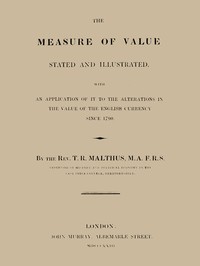
The Measure of Value Stated and Illustrated: With an Application of it to the Alterations in the Value of the English Currency since 1790
Written by T. R. (Thomas Robert) Malthus
Chaptra reads alongside you — AI insights, chapter breakdowns and reader discussions for every book. Join free
About this book
Reading guide
Themes, characters and key ideas in The Measure of Value Stated and Illustrated: With an Application of it to the Alterations in the Value of the English Currency since 1790, written by Chaptra AI.
- about 15 hours
- advanced
- Analytical
- Academic
- Rigorous
T. R. Malthus's "The Measure of Value Stated and Illustrated" is a foundational early 19th-century economic treatise that rigorously examines the concept of value, distinguishing between 'value in use' and 'value in exchange.' Malthus endeavors to establish a reliable, absolute measure of value, arguing for the necessity of using labor as a primary yardstick for economic assessment to accurately gauge purchasing power and economic dynamics over time. The work critically analyzes the impact of labor, profits, and the interplay of demand and supply on commodity values, culminating in an application of his theoretical framework to the historical fluctuations of English currency since 1790. It represents a significant contribution to classical economic theory, aiming to provide a scientific basis for understanding economic worth.
“"The great and paramount use of a measure of value is to determine the laws according to which the precious metals, or any other article, exchange for the great mass of commodities, in the actual transactions of commerce."”
Key themes
- The Nature of Economic Value
- Malthus deeply explores the fundamental question of what constitutes economic value, meticulously distinguishing between subjective 'value in use' (utility) and objective 'value in exchange' (purchasing power). This theme is central to the entire treatise, as he seeks to clarify and standardize how value is understood and measured in economic transactions, laying the groundwork for his subsequent arguments.
- Labor as the Foundation of Value
- Malthus's adherence to a labor theory of value is a central pillar of his argument. He posits that the value of a commodity is ultimately determined by the quantity of labor required to produce it or the quantity of labor it can command in exchange. This theme is explored through his analysis of how wages, profits, and the 'natural price' of labor influence the worth of goods.
- The Search for an Invariant Measure of Value
- A core preoccupation of the book is the quest for a stable, absolute measure of value that can accurately reflect the worth of commodities and currency over time and across different regions. Malthus critiques various potential measures, ultimately advocating for labor as the most consistent standard, believing it essential for sound economic analysis and policy.
Worth discussing
To what extent is Malthus's distinction between 'value in use' and 'value in exchange' still relevant in contemporary economic thought?
Chapter-by-chapter breakdowns, character arcs and the full thematic analysis come with a free account.
Discussions
No one has started one yet
Questions this book opens up
No discussions yet
Be the first to start a discussion about this book!
Sign up to start the discussionReviews
No reviews yet
Be the first to review this book!