
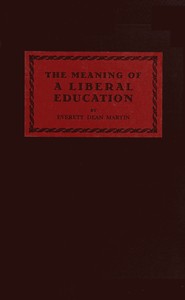
The meaning of a liberal education
Written by Everett Dean Martin
Chaptra reads alongside you — AI insights, chapter breakdowns and reader discussions for every book. Join free
About this book
Reading guide
Themes, characters and key ideas in The meaning of a liberal education, written by Chaptra AI.
- about 10 hours
- advanced
- thought-provoking
- analytical
- critical
Everett Dean Martin's "The Meaning of a Liberal Education" is a seminal early 20th-century philosophical treatise that sharply critiques prevailing educational trends, particularly in America. Martin argues passionately for liberal education as a transformative process cultivating independent thought, self-mastery, and a profound understanding of human existence, contrasting it with mere vocational training or propaganda. He observes a misguided enthusiasm for education that often prioritizes utility, quick results, and conformity over genuine intellectual growth. The book champions education as a lifelong pursuit essential for the development of critical individuals and a healthy democratic society, advocating for a return to its deeper, humanistic aims.
“The educated man is one who has learned how to learn, and who knows that education is a lifelong process.”
Key themes
- The Nature and Purpose of Liberal Education
- This is the central theme, exploring Martin's definition of liberal education as a transformative process focused on cultivating independent thought, critical judgment, and self-mastery, rather than mere skill acquisition or vocational training. He distinguishes it sharply from education driven by utilitarian ends or social engineering.
- Critique of Utilitarianism and Conformity in Education
- Martin severely criticizes educational systems and public attitudes that prioritize practical utility, organizational efficiency, and the production of compliant citizens over genuine intellectual growth and individual autonomy. He sees these trends as undermining the very essence of true education.
- Individual Autonomy and Self-Mastery
- A core outcome of liberal education, according to Martin, is the cultivation of the individual's capacity for independent thought, self-reflection, and moral agency. This leads to a profound sense of self-mastery, enabling individuals to resist external pressures and pursue truth for its own sake.
Worth discussing
How does Martin's critique of early 20th-century education resonate with contemporary educational debates and trends?
Chapter-by-chapter breakdowns, character arcs and the full thematic analysis come with a free account.
Discussions
No one has started one yet
Questions this book opens up
No discussions yet
Be the first to start a discussion about this book!
Sign up to start the discussionReviews
No reviews yet
Be the first to review this book!