
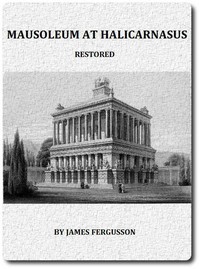
The Mausoleum at Halicarnassus Restored in Conformity With the Recently Discovered Remains
Written by James Fergusson
Chaptra reads alongside you — AI insights, chapter breakdowns and reader discussions for every book. Join free
About this book
Reading guide
Themes, characters and key ideas in The Mausoleum at Halicarnassus Restored in Conformity With the Recently Discovered Remains, written by Chaptra AI.
- about 10 hours
- advanced
- scholarly
- analytical
- historical
James Fergusson's "The Mausoleum at Halicarnassus Restored" is a pivotal 19th-century architectural and archaeological treatise that meticulously attempts to reconstruct one of the Seven Wonders of the Ancient World. Published in response to Charles Thomas Newton's significant excavations, the book offers a detailed, evidence-based interpretation of the Mausoleum's original form, dimensions, and artistic ornamentation. Fergusson critically analyzes existing historical accounts and newly discovered fragments, proposing a comprehensive vision that challenged previous speculative reconstructions. It stands as a testament to the rigorous application of architectural history and archaeology in understanding ancient monumental structures.
“It is only by a careful combination of all the evidence that we can hope to arrive at anything like a correct appreciation of its original form.”
Key themes
- Archaeological Reconstruction
- This is the central theme of the book, exploring the rigorous process of piecing together a lost ancient structure from fragmented remains and historical accounts. Fergusson demonstrates the challenges and methodologies involved in translating disparate evidence into a coherent visual and structural understanding.
- Architectural Interpretation and Theory
- Fergusson's work is deeply rooted in architectural theory, using comparative analysis and an understanding of ancient building practices to inform his reconstruction. He interprets not just the physical form but also the aesthetic and structural logic behind the Mausoleum's design, placing it within the broader context of ancient architecture.
- The Nature of Evidence and Scholarly Rigor
- A foundational aspect of Fergusson's approach is his meticulous evaluation of evidence, distinguishing between reliable archaeological finds, credible historical texts, and speculative assumptions. The book champions a rigorous, evidence-based methodology as opposed to imaginative conjecture.
Worth discussing
How does archaeological evidence constrain and inform architectural reconstruction?
Chapter-by-chapter breakdowns, character arcs and the full thematic analysis come with a free account.
Discussions
No one has started one yet
Questions this book opens up
No discussions yet
Be the first to start a discussion about this book!
Sign up to start the discussionReviews
No reviews yet
Be the first to review this book!