
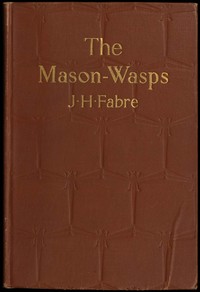
The Mason-Wasps
Written by Jean-Henri Fabre
Chaptra reads alongside you — AI insights, chapter breakdowns and reader discussions for every book. Join free
About this book
Reading guide
Themes, characters and key ideas in The Mason-Wasps, written by Chaptra AI.
- about 8 hours
- intermediate
- informative
- observational
- curious
Jean-Henri Fabre's "The Mason-Wasps" is a seminal work of natural history and entomology, meticulously documenting the lives of various wasp species, with a particular focus on the Eumenes. Fabre, a keen observer, blends scientific rigor with an engaging narrative style to explore the intricate instinctual behaviors, architectural prowess, and survival strategies of these insects. The book delves into their nest construction from dust and saliva, their hunting methods, and their life cycles, offering profound insights into the natural world. It stands as a testament to the wonders of instinct and the beauty of detailed scientific observation, making complex biological processes accessible and fascinating to a wide audience.
“The instinct of the insect is a marvel of precision, a perfection of predetermined action that shames the clumsy efforts of human reason.”
Key themes
- The Mystery of Instinct
- Fabre's central preoccupation is the profound nature of instinct. He meticulously documents the complex, unlearned behaviors of wasps, such as nest construction, prey paralysis, and provisioning, questioning whether these actions are purely mechanical or if a spark of intelligence guides them. He consistently marvels at the precision and perfection of these innate behaviors, often concluding that instinct is a more profound and mysterious force than human reason.
- The Ingenuity of Nature's Design
- Fabre showcases the incredible efficiency, adaptability, and intricate beauty embedded in the natural world. Through the Mason-wasps, he illustrates how evolution has crafted perfectly suited behaviors and physical attributes for survival, reproduction, and ecological balance. The wasps' ability to utilize simple materials for complex structures and their specialized hunting techniques are presented as exemplars of nature's unparalleled engineering.
- The Scientific Method Through Observation
- Fabre's work is a testament to the power of patient, meticulous observation as a cornerstone of scientific inquiry. Despite lacking modern technology, his ability to spend countless hours watching, recording, and performing simple, elegant experiments demonstrates a profound commitment to understanding the natural world directly. He emphasizes forming hypotheses, testing them through repeated observation, and drawing conclusions based on direct evidence.
Worth discussing
How does Fabre's blend of scientific observation and literary prose enhance the reader's understanding and appreciation of insect life?
Chapter-by-chapter breakdowns, character arcs and the full thematic analysis come with a free account.
Discussions
No one has started one yet
Questions this book opens up
No discussions yet
Be the first to start a discussion about this book!
Sign up to start the discussionReviews
No reviews yet
Be the first to review this book!